

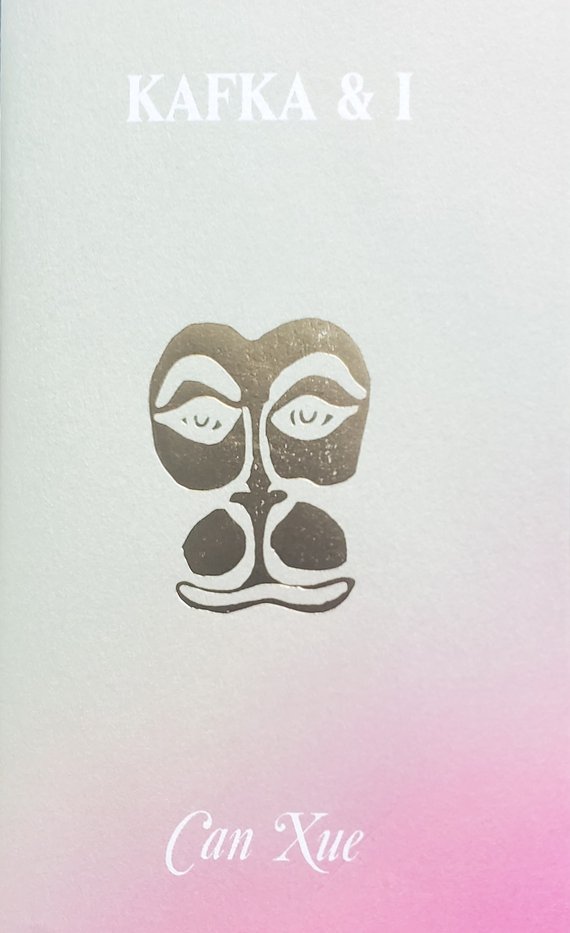
Deceptive.
Since I spent 17$ on this without realizing it was a scarcely a pamphlet, 3 inches tall, perhaps it’s my fault. The contents would fill perhaps 20 normal-sized pages.
It contains an introduction by the editor and 3 essays from Can Xue, who is one of my favorite authors, whose books I buy blindly. The essays are expositions of Kafka stories, with Can Xue’s interpretation. They do not cover a wide range of Kafka’s work and are limited in scope.
In my opinion this is a disappointingly paltry production.
I disagree with Can Xue’s summation that Kafka is the “most feminine-minded of male writers.” I don’t believe she demonstrates this in her essays and the believe may stem from her personal identification with a few female characters in the stories described. The bulk of Kafka’s stories and especially his unfinished, sloppily composed novels, do not deal fairly with women characters, neither explore their consciousnesses in any depth. There are exceptions. I thought the characterization of the sister in The Metamorphosis was brilliant, for instance. The prime example in this volume comes from ‘Josephine the Songstress.’ Also covered is ‘Brunelda’s Song,’ (in Amerika). To me these are both not representative of Kafka’s strengths. Kafka could write with incredible depth, but he could also fall into quibbling, wandering narration, blatant silliness, and countless eccentricities.
Can Xue also indulges in this haphazard manner of composition, stringing together unrelated thoughts and scenes to convey and atmosphere. It’s safe to say that her style might derive partially from her perception of Kafka’s method. However, Can Xue remains a genius in my estimation. She claims to never revise her fiction or bother about rereading it. She purports to be publishing first drafts. Kafka could never claim to do that with his best work, though he considered his own writing worthless by the end of his life.
The mystery of these two writers, linked through a skewed manner of perception, is worth pondering.
This book will be a complete waste of money for most and seems to be part of a small print run of a micro press, destined. to disappear from libraries and bookstores in a short time, like her impossible-to-find book titled ‘Purple Purilla.’
Why is Can Xue’s team of English translators selling her backlog of works to small, invisible presses?
Obviously, a wider audience already clamors for her new translations. Her novels seem more popular than her stories, though I prefer the latter.
There are still countless productions planned for release in English. Can Xue is unstoppable, inimitable.
But people have been imitating Kafka for centuries, and he hardly finished anything of length to his own satisfaction. Can Xue’s confidence is admirable, and why she esteems the timid, hesitant, plodding Kafka so highly is her own secret.
Most amusing still is Can Xue’s bizarre method of argument, akin to her off-kilter fictional descents into unfocused symbolic vagueness.
Like Haruki Murakami, she does not bother to define her symbols, but includes them for the sake of the image.
I remain unconvinced whether Kafka inserted many of the perceived layers in his work through careful consideration. I do not imagine that he labored over countless drafts and corrections. The hidden meanings in The Metamorphosis and his short stories seem dredged up out of his subconscious in a breathless hurry of slipshod composition. As for his novels, the interior meanings strike me as more obvious. To his credit there is a lot there. You can spend a lot of ink teasing out every last interpretation of his minor and major works. They playfully remain open-ended, underscoring the shortness and inadequacy of his life.
Contrast this with Can Xue’s ultraproductive almost disturbing disregard for conventional storytelling and popular genres. Yet incredibly, her works slide easily into the category of literature, avoiding the doom of the literary fiction category. The magic realism is often nonexistent or so subtle as to be not worth mentioning.
Faced with the impossibility of keeping this book in my collection, it did make me think harder about both author’s place within my personal canon. (Seriously, I can’t put a match-box sized book on my crowded home library shelves).


Leave a Reply