

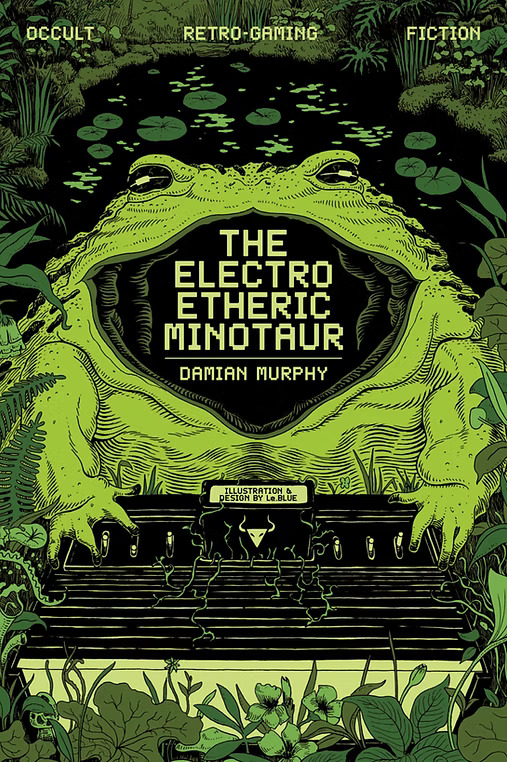
Damian Murphy’s new collection is my favorite of his works so far.
The pervasive mode here reminded me of the film Obex in a few places.
As usual, the stories take place tangential to our reality. Characters discuss video games with the seriousness of collectors, obsessors, theorizers. To truly get into a video game to the fullest extent, one must become Odysseus, strapped to the mast, ready to endure any temptation.
The Mansion of Sapphire – my 3rd reading. It holds up as one of the greatest short stories I’ve ever read. One of my favorites, clearly. Borges would’ve admired it, if he’d understood video games. It describes one character playing a retro game with intermittent breaks to attend to her work and other necessities. It contains luscious descriptions, extravagant even by Damian Murphy’s standards. The main character’s obsession with and exploration of a pixelated universe provides the premise. Her virtual quest mirrors her internal striving after the ineffable. This interior abasement and submission toward the mysterious entities that lay beyond ordinary perception could be called the driving forces behind all of Damian Murphy’s stylized literary work. The narrator’s encounter with the limits of human perception through the medium of the game is exquisitely rendered. The story possesses uncanny occult resonance. The imagery is undeniably compelling, but what is more moving and unforgettable than the cloaked symbols is the character’s commitment to expend her precious life energy as a sacrifice to the demands of esoteric knowledge.
This book is hauntingly illustrated with intricate line drawings. It is also well-designed and very readable. Unlike other video game-themed fictions, like 8-Bit Bastards or 8-Bit Apocalypse, there is a paucity of video game action scenes here. Battles and outward conflicts are seldom present in Damian Murphy’s writing. Many of his stories feature only one character, or a few at most. This approach allows the reader to become immersed in the environment described and experience the interior landscape hinted at through the characters’ interactions with the off-kilter settings. There is much discussion of video games in these pages, and many technical details are of interest to enthusiasts.
“Magnetic North” invites the reader to listen in on an interview with a game designer who only edits previous video games to release them in limited numbers as clandestine alternate versions. This behavior fits in with the author’s prevalent concern with subtle sabotages. The descriptions of retro gaming concepts are magnificent. They conjure a persuasive blend of mystic encounters with occult mysteries and vintage game aesthetics. The character explains her philosophy of adjusting a game’s orientation within virtual reality, thereby establishing access to previously unexplorable areas. The player must depart from the prescribed way to discover the alternate content within the game. More intriguing is how, on a subliminal level, the reader is tasked with seeking solutions to Murphy’s writing by stepping off the straightforward path. Indeed, like an iceberg, the stories contain content beneath the surface level. However, much of the universe, both literary and external, is beyond knowing. Yet, what we inevitably find inspires us to delve deeper. The power of his ideas to evoke sublime understanding will not escape even a casual reader.
As regards the peculiar title, it yields to interpretation if you break it down: The minotaur guards the labyrinth. The labyrinth conceals knowledge. The gatekeeper is virtual in form and ethereal in nature. The author holds the secrets here, constructing an elaborate maze around patterns and practices beyond the ordinary reader’s ken. He or she will have to leave the familiar precincts of basic narrative elements to get at the roots of totems, key expressions and symbols.
The titles of false video games used within are good examples.
Be not dissuaded. The stories are enjoyable on every level, from any angle, and innovative in structure. Design and care went into every layer of the production.
Like the pseudo video game codex called Vermis, this book is a gateway to another realm. The reader experiences a video game vicariously (as is always the case).
If only Damian Murphy would continue this series of stories. Perhaps he will write video game reviews for titles that do not exist. I want to read more.
I enjoy reading about video games as much as I enjoy playing them.
“A Night of Amethyst” is an homage to point-and-click adventures. The reader becomes the player in a minute traversal of interiors. This story has appeared in anthologies and I believe it sparked the interest in this theme which ultimately resulted in this collection. Dreamlike avenues unfold as the characters make unsettling choices and the conclusions consume them, leaving the reader with many unanswered questions on a first reading.
The cover and art reminded me of early video game box art and match well with the writing. I sometimes which more hand-drawn or hand-painted covers were used for games and books. Alas, as Bitmap Books attests in their line of box art compendiums, hand-crafted covers are a dying art.
Whether he is describing cut scenes or a game’s irresistible soundtrack, his language is the method of seduction. His style justifies any eccentricities he implants in the tales. The storytelling techniques vary, and the pacing is slow, but the aesthetic is unmatched.
Expect subversion. There is nothing of conformity here.


Leave a Reply