
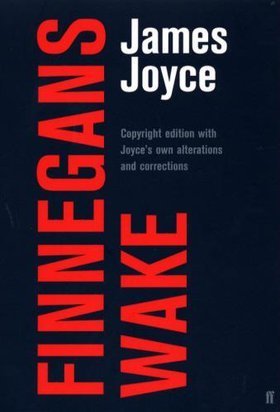
Sampling the audiobook is fun.
Reading it aloud is equally rewarding. Or perusing, picking out at random, focusing, underlining. All of these activities deliver enjoyment.
One can take small bites, or power through. There is no set way to tackle this book.
As everyone knows, Joyce spent 17 years writing this. That is significantly longer than he spent writing Ulysses of course. One might wonder why he put so much effort into something so odd?
Perhaps this is the ultimate expression of what Joyce viewed as literature.
Whenever I dip into the Wake, I wonder if Joyce approached reading and writing very differently from other people and most other authors. He apparently compiled the “Work in Progress,” as it was called, in tiny fragments, writing sometimes in crayon, a couple words per sheet of paper, as his eyesight failed.
One could not count the number of drafts he must’ve done. I’m reminded of Hemingway who produced 64 drafts of The Old Man and the Sea, on a typewriter, creating a stack of paper taller than him. And Milton who dictated, while blind, some of the best lines in the English language, in a total submission to vocal cadence and mental composition.
Why don’t all authors spend so much care on their productions? Would the world of literature be better off if writers committed to only producing their greatest expressions, their most revered thoughts and opinions, synthesized over a chunk of a lifetime into a few key works? Perhaps. We’d have fewer disposable novels, reruns playing in the theaters of our minds, stacks of genre fiction moldering on the shelves. There is a time and a place for this approach. You have people like Arno Schmidt who picked up where Joyce left off. But why do fewer people become absorbed in the shaggy monsters of Schmidt’s wallet-crushing books? Obviously they have limited appeal. It is possible to glean nothing from whole pages of Schmidt, whole hundreds of pages, to retain nothing, unless you have a special interest in his weird word playground. The world appears like that of the flatlanders, a 2d code of lingual dexterities. In me, his attempts only inspire weariness.
What is different about The Wake? Many will never experience a jot of its majesty. They will stop at Dubliners or Portrait or Ulysses. But will they know the real Joyce if they do that? I get the sense that this is Joyce’s angry and sad testament to the world. That he got so lost in this labyrinth of language, that he forgot the languages of men, trading in character and plot for symbolism and secret. But there is much truth, must mysticism, and much madness in this massive, multifaceted, protean crustacean of a book. One can become infected by the gross, elaborate whirlwind of ecstatic polyglot. One can apply Pardes to the layers of text, or as some mathematicians decided to do, add up the numbers of words in Joyce’s sentences and find the abstruse answers to arcane proofs, while missing the point of the inherent words and pseudowords. Portmanteaus enliven the book, which is brimming with a peculiar lexicon of Joyceanisms. Translated through the rhythm of speech, we can dig through the subtexts and slowly compile meanings upon meanings. Architectures emerge.
Somehow, the work of Schmidt and other imitators strike me as feeble, impressionistic mosaics of largely extraneous dream-dross. Though they each have their specific merit, Joyce will remain singular and unimpeachable until AI rises to produce works which make sense only to it, guided by the solid-gold-magicarps of its alien non-intelligence, as language departs from the human sphere, and people cease to rely on printed books. Where a few hair-shirted monks entangle the confusing proliferations of language which exploded during our unremembered era, centuries from now, when deep-mind analyses of the Wake have yielded millions of words of expounded references and uncovered windows into the mind of man, who foolishly calls himself modern at the start of each generation.
The Wake is a tide, eternal, crashing upon the barren shores of our meager understanding.
It is the path Joyce carved through the ocean of noise. It is the sudden start into awareness that this whole medium of storytelling is porous and unsound, that its meander is contrived from the dregs of DNA, history, and amorphous human desires.
Many books have been written about the Wake’s enigmatic contents explicating and interpreting the ciphers for you. There is even an online resource which explores the work word-by-word. But I find it much more fun to elaborate on Joyce’s choices without the aid of scholarly opinions.
Starting with only the 1st page as a sample, I circle things, meditating upon them. One finds evidence of the circular structure at several levels. Word, sentence, paragraph, section, and book. The motif of rivers: “livvy” and isthmus, peninsula, sea, bay, shore, etc.
Showing how shallowly the publisher was probably attending to Joyce’s subtleties, “venis” and “penis” are scarcely hidden within the first 100 words. Joyce implants hundreds of silly puns and stilted jokes inside otherwise somber passages.
In the word “aquaface,” we may imagine God hovering over the face of the deep.
“retaled early in bed and later on life down through all christian minstrelsy.” – this segment encourages us to read the work like a bedtime fairytale, and then come back later when we have grown in wisdom and moral instruction, when we have understood God’s word, which will be sprinkled everywhere like a seasoning, like a breath of life and signposts of civilization in the wilderness.
The 1st sentence supplies a reference to Vico, one of Joyce’s inspirations. This old guy postulated that history follows cycles. HCE becomes a major character. He is botha. place and a person. The reader must indwell him, mind and body. “recirculation,” takes us into his very bloodstream.
The other modus operandi apply from the start and build on one another for the length of the text, rarely slowing down to actually describe images or people. Up to 5000 characters have been counted and indicated by certain scholars within these densely packed 628 pages, and I get the sense that if Joyce had lived longer, or could’ve lived longer, that this would’ve remained unfinished forever, simply abandoned before death, bequeathed to the world without explanation.
There are several references to Genesis starting from the first line, taking us on page 2 to the other books of the Pentateuch. To me this speaks of the method of reading we must employ. It is a claim that what we hold in our hands is as inexhaustible as scripture, if only we are willing to linger in its depths. We see references to armor, spliced inside other words, “wield,” “fight,” “war”.
The burning bush appears, Dublin becomes “doublin.” From this we infer that double meanings are to be expected. Verily, the number of meanings for each word and expression will continue to multiple as we proceed.
“The fall” opens the 3rd paragraph, treating us to one of the “thunder words” within the books, easily spotted by their 100-letter length.
Joyce employed more than 60 languages throughout, but an unknown number of them mingle and converge within this word and at every stage of the journey.
The book begins with the fall of Finnegan, which represents the fall of man, as indicated early on, contrasted with the fall of Humpty Dumpty and other interesting contrasts. Birth and death are alluded to. Is this story in front of us the tale of life after death? Or is it all a dream. Sleep is a preparation for death. The entire narrative unfolds as the titular Finnegans (plural) fall and wake successively. He is laid out, body displayed. HCE seems disembodied at times.
One easily spots the Biblical names: Isaac, Nathan, Shem, Joseph, etc.
The first page is a representative trove of interpenetrating elements, drawn from key literary roots.
Read it and be astounded. Read it and be confounded. Read it. And weep. Return to the start, reread, run through it, wake, sink back beneath its waves, encounter the flotsam and jetsam, taste, imbibe, and come up gasping for air when you tire.


Leave a Reply