
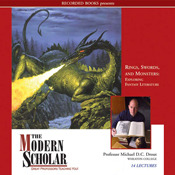
This run-down of the Fantasy genre was heavily skewed toward Tolkien studies.
I worry that colleges will start to have departments for Tolkien, like they have for Shakespeare.
The nerdy fandom in this lecture series is somewhat controlled, and a lot of the background sources of Tolkien’s world are discussed at length. I learned a lot about him, and listening to this made me want to reread the series.
Of course, many important series and fantasists are left out. Arthurian fantasy is discussed. And the roots of fantasy in Gilgamesh and Beowulf and Homer. I like how this professor equates literature with Fantasy. His explanation of what has been sidelined too often as an unimportant genre, but which is really the heart of all literature was inspiring.
When you think about the works of Roth, Updike, and Henry James. They have played into this elitism that anything containing fantasy is for children. Updike seems to have tried his hand at fantasy and produced the worst stuff he ever wrote. James wrote nonfiction on the topic.
Drout breaks down what the best works of fantasy do, and why they count as literature. I have often wished that James and other Realists would loosen up and include fantasy elements in their repertoire. They are so constrained by the desire to depict psychology of realistic characters, they seem to forget that their entire books are invented and therefore fantastical. It is just a form of fantasy lacking imagination in a lot of respects.
Of course, the discussion of fantasy goes on to encompass the inspirations for Tolkien, C. S. Lewis, and others, deriving from The Water Babies and The Princess and the Goblin, Alice and Wonderland and others. Then he relates how all fantasy writers must contend with Tolkien forever after. They either must react to him or imitate him.
I think there have been many attempts to create unique fantasy worlds. But when examined closely, a lot of them do seem derivative.
But the same could be said of Faulkner, Shakespeare and others. Derivative doesn’t necessarily mean bad.
I agree that Donaldson needed to lay off the thesaurus. He goes off on quite a tangent bashing Donaldson’s prose. Try though, the man writes some of the highs and lows of prose style in the genre, but the overall impression still lingers.
He did not seem terribly enthusiastic about Harry Potter, which was refreshing.
Pullman’s books were described as annoying, which I felt was a just take.
I am determined to read more Le Guin now. He ranks her as second to Tolkien. Then he overrates Holdstock. Mythago Wood had good ideas, but it was also an awful book. Not nearly as well-written as anything Le Guin has done.
I’m also going to try more William Morris, T. H. White and other authors he recommends.


Leave a Reply