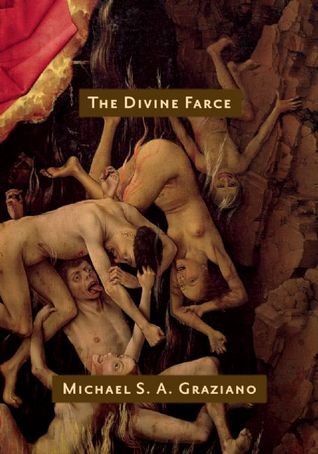
The title led me to anticipate some element of comedy in this novella. Instead I got a bleak Boschian panoply.
Farce also denotes improbability, so it still fits, I suppose.
The initial description of a Sartre-reminiscent version of Hell was compelling, but it could not be sustained indefinitely. Thus, I was glad when the narrative branched into unexpected, bizarro territory.
What most fascinated me were the descriptions. The people met by the narrator adapted to their environment, and thus became animalistic, as one would expect. Adverse conditions seem to magnify humanity’s flaws. Humans morphed to fit the environment. The environment took part in the plot, dictating how the narrator responded.
The author sought to allegorize common fears and hang-ups, to extrapolate to extremes the contents of a peculiar nightmare. Nightmares often run off themes and the fumes of base emotions. This small book functions in the same way. One is left without explanation, broadly at a loss to excuse human experience or the purpose of the universe. Why does the universe work in exactly the way it does? There is absurd beauty in the self-sustaining nature of this afterlife scenario. Yet, the ultimate origin of the resources, of the materials, of the organization, and the long-term goal of the set-up are beyond the scope of the main character’s perception. He extends his reach as far as humanly possible, but that ends up being not very far at all, pathetically un-far.
The sardonic narration compliments the gray, brown, mucky color palette.
I would certainly read more books in this vein. Alas, it seems the author’s other books are not comparable to this in terms of world-building.
Recommended for horror enthusiasts seeking something different.
Everyone compares this to A Short Stay in Hell. The comparison doesn’t do it justice. I know how it feels to have one’s book continuously compared to another author’s book. I will say they are not similar except that they are both are passed off as taking place in the afterlife. But there is no guarantee that this is a legitimate afterlife story. There is also no indication whether the characters must reside in the setting as a result of their actions or if it was just random chance. There are only three causes in the universe: random chance (although true randomness is far more rare than most realize), design, and inevitable natural forces. None of those seem like a good enough candidate for an ultimate cause of the plenitude of suffering. Higher-level, imperceptible forces or intelligence must be at work. That seems to echo through the subtext here.
What it lacks in psychological complexity, it gains as a streamlined descent into cinematic hell.
Doris Lessing’s Memoirs of a Survivor, on the other hand, is too bogged down with psychological discernment and various ramblings to actually reach the heights of literary precision this book offered.
I am reminded of the Netflix film called Platform.
A very easy, one-sitting read. Plenty of dribbling bodily juices, squelching through effluence, and fondling grotesque flesh phalanxes to satisfy any fan of Lovecraftian yuckiness.


Leave a Reply