
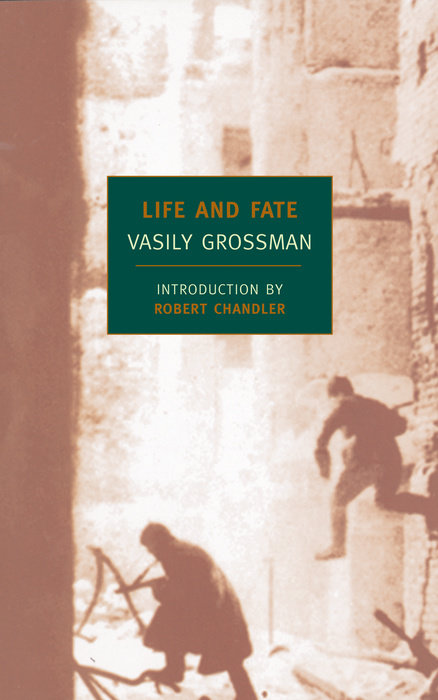
My shelf is being weighed down by hefty NYRB classics now.
I jumped into this one without reading Stalingrad after finishing War and Peace earlier in the year. I was quickly intrigued by the scenarios within. There are too many characters to track in my opinion. The point seems to be to feel the texture of the times, compiled of tidbits and dioramas, miniature moments, so that a sense of the whole vastness of that world is communicated through exposure to these intense, dreamy episodes.
Lots of meandering narration on the effects of warfare from the bottom to the top, among ordinary, frightened people. To live is to know fear. One gains a sense that life seems inadequately fair, that provisions for our happiness are missing from the equation.
The convos between the physicists are fascinating, regarding the conversion of inanimate matter into animate matter as life taking over the darkness, the universe coming alive. We humans, disseminating, enlarging our scale into the atom and into outer space, all the while man’s moral power remains stunted. Man wishes to rise above god but is still mastered by the devil, the universe could turn into a gulag, ruled by enslavement on a galactic scale if we don’t first master ourselves. The capacity for human cruelty seems infinite in the face of our history. Will the future reveal that we’ve grown at all?
“we think we’re so wise – to us Hercules seems like a child with rickets. And yet on this very day the Germans are slaughtering Jewish children and old women as though they were mad dogs. And we ourselves have endured 1937 and the horrors of collectivization – famine, cannibalism and the deportation of millions of unfortunate peasants… Once, everything seemed simple and clear. You say man will be able to look down on God – but what if he also becomes able to look down on the Devil? What if he eventually surpasses HIM? You say life is freedom. Is that what people in the camps think? What if the life expanding through the universe should use its power to create a slavery still more terrible than your slavery of inanimate matter? Do you think this man of the future will surpass Christ in his goodness? How will the power of this omniscient and omnipresent being benefit the world if he is still endowed with our own fatuous self-assurance and animal egotism? Our class egotism, our race egotism, our State egotism, and our personal egotism? What if he transforms the whole world into a galactic concentration camp? Do you believe in the evolution of kindness, morality, mercy? Is man capable of evolving in that way?”
We seem always to be searching for goodness in others and finding disappointment. Idealist leaders promise a utopia and deliver a hell on earth.
It is all most people can manage to survive, to eke out a living, to cope with the environment in which they were placed against their will, to find some solace in a lover or a spouse or a child, to cultivate some small patch of happiness in a cruel world which is like a tempestuous sea—we are tiny islands, small lights in a measureless darkness.
The inhabitants of this continent-sized novel are humanized, they develop cultural cues in order to survive, languages adapt within the gulag, develop as a means of coping. People turn to simple pleasures. Each day is a breathless sprint toward the next possible escape.
It is a novel that operates through accumulation of small vignettes, a catalogue of atrocities, a compilation of detailed character descriptions and telling thoughts, anxious thoughts, illustrative of the desperation of a nation or of an infantry unit, or a housewife, or a general.
The folly of human rulers comes through on every page.
Passages combine from different vantage points to create a startling mosaic, depicting small daily actions that illuminate people’s lives in dark times, interspersed with essayistic generalities, analyses of human stupidity. Warlike behavior manifests in myriad ways. The conflicts are variously justified and disparaged, their rippling consequences jostle all the characters’ daily routines. They disguise the ramifications of the larger conflict incessantly. Humans will speak about the greater good, to explain away any evil.
This is more modern than war and peace, perhaps more down to earth, relevant, readable. But lacking something in focus. It’s companion Stalingrad, promises to be more of the same bleak depictions of fronts, both of the home and of the heart.
Tt puts you in the bunker in the midst of bombed cities under siege.
The sounds of explosions can be heard, but Byerozkin says “things are very quiet here.”
“good men and bad men alike are capable of weakness. The difference is simply that a bad man will be proud all his life of one good deed – while an honest man is hardly aware of his good acts, but remembers a single sin for years on end.”
“this isn’t science – it’s a blind couple trying to screw in a patch of nettles.”
“you can’t see the significance to physics of your own mathematics. It’s like the cat in Alice in Wonderland – first you see the smile, then the cat itself.”
More essays interspersed might’ve been warranted. Might’ve relieved some of the sense of sameness.
Postwar Russian literature seems geared toward depicting the widespread oppression of a people ultimately enslaved by ideologies. But individuals are more concerned with human suffering than the vast ideological machine.


Leave a Reply