

‘an uninhibited lecher who operates in an unbridled frenzy may be nothing like as corrupt as one whose lechery observes decorum.’
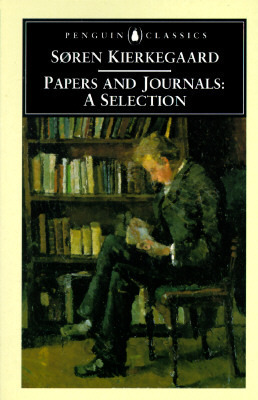
The original unabridged journals are 10,000 pages in some editions. That strikes me as excessive. Kierkegaard was clearly a compulsive writer. Over the course of 700 pages, I experienced a keener understanding of his mode of discourse and way of thought, but was also surprised by the lack of variety. Reading Emerson’s and Thoreau’s journals left a very different taste. In Emerson, you get a lot of raw thought, speculative logic. In Thoreau, much poetry. Thoreau’s is by far the most vivid. Kierkegaard, on the other hand, is so focused on the purpose of thought, action, philosophy, religion, abstraction, morals, and fame. His preoccupation does a disservice to the potential of writing to convey many angles of a life. His lifestyle seemed far too constrained in my view. This diary reads like the literary Lives of the Saints. But his meditations are often apt, regarding his specialized interests.
He loved only one woman in his life, she was like his Beatrice, his Dulcinea, they came close to marrying, but he broke it off, and seemingly regretted it for the rest of his life. Thereafter chastising himself, and celebrating his celibacy. Romance seemed incompatible with his worldview, which I find sad, because not all forms of romance have to fit in with societal expectations. I wonder what he made of Abelard and Héloïse.
His obsession with pseudonyms seemed silly. This leads into a preoccupation with what the public thinks of him. This vanity runs through his diary like a virus. For someone so practical in other areas of theology, I find his vanity here surprising.
Of course, he refutes Hegel, with verve. He provides practical advice on wrestling with the question of how to live. This takes on myriad forms, but always circles back to Regine, and what being with her would’ve deprived them both of.
Nonetheless, this is one of those books which may aid you in discovering how to think and push the limits of thought.
As a scholar, his output is impressive, and the depth with which he explored theological matters rivaling Augustine, or at least adding meaningfully to the canon. He spoke several languages and died at age 42 after producing 8000 pages of well-honed religious philosophy—apart from the voluminous journals.
What this book does in part, is sonstruct a knowledge base from which to operate on a human level, elsewise explored within his other works. Logic in service to theology. Combining innate wisdom with an approachable style and prolific examples.
Starting in 1848, the focus shifts from his spiritual thoughts to a disgust with the treatment of him by journalists. His struggle to be accepted by the public and his disdain for the politics of the publishing industry of his age are what I would expect, having heard nothing but scorn from authors as regards to the publishing apparatuses they are subject to.
His enjoyment of Schopenhauer and his concern at the irony of the way the man doesn’t live up to what he preaches was likewise amusing.
Too many are content with worshipping God and forget they have to imitate Christ. – This was a key tenet of his thought. God wants imitation.
He describes marriage as egotism. Too often, he doubts the value of marriage.
Discussions continue, covering dualism, evil as a corruption of good, light revealing light, the leap of faith, mental faculties constructing analogues with nature, peoples’ changing attitudes toward God.
The ego posits itself. It needs no spurring on. Snacks for thought. Such enviable articulation.
‘It seems to me that the stone laid before Christ’s grave might well be called the philosopher’s stone.’
His expression of will as a condition of living, and yet, how to be an instrument of the Deity.
He purports humility before immanent greatness, but does his own behavior live up to that ideal? How can one wish to be great, to leave a timeless testament, while living in humble, worshipful imitation of the Savior?
Controversies of his day: The debate whether the Bible is the divine word or the word of inspired men and if translations are assailable.
Some lucid abstract pondering. Details of signs hidden in the world which prove God’s existence.
Some about finding one’s truth and purpose, thirsting for truth, finding true love to share life’s joys and burdens, don’t be tempted by the world. (But also don’t get married, he says.)
In the end we must construct systems to understand how the world works. This is fundamentally separate from experiencing life meaningfully.
He worries how people will use his writings and misinterpret them. Can they stand the test of the world?
Living a life in pursuit of knowledge. If only all of us could while away so much time delving into spiritual principles and ultimate meanings behind the veils of Creation.
Does knowledge of the world lead to madness? How living in the world constitutes suffering. The world is a labyrinth, whose minotaur demands sacrifice. Finding the self, discovering the pathway to the kingdom of heaven.
‘One must first learn to know oneself before knowing anything else.’
For my part, I find that the more philosophers I read about, the less confidence I have that the philosophers in question understand themselves.
Don’t begin on life’s path out of a state of not-knowing.
His thoughts on Plato, socrates, how to withstand ‘life’s squalls,’ how circumstances dash away our hopes. We may cultivate spiritual knowing, forego contentments, if we are guided by an inner compass, staying afloat in the storm, but easily succumb spiritual laziness, if we choose quick solutions. So we become the liar who believes his own stories,
Real life, as other’s define it, shouldn’t interest us much, according to the self-proclaimed sage. Living the examined life is all that matters in his eyes. Yet the limitations of philosophy will only allow us to plumb so deeply before we run up against the pit of fundamental faith questions.
Are we like Don Quixote, who blames his madness on devils?
The author speaks of the spiritual corset, advocates for moderation in Christian tenants, and doesn’t seem to side with zealots. What he seeks is the permeation of Christianity.
Great authors ought not to praise their work, he says. However, he praises his own a great deal.
‘half of life for living, the other half for regretting.’
That strikes me as true.
Don’t follow the times but be guided by a moral ideal. Allow your convictions to form over a long time.
‘life can only be understood backwards but it must be lived forwards.’ Obvious. But once you hear it articulated like that you’re unlikely to forget it.
Hegel ‘tried to board Heaven by a ladder of arguments.’ Nice analogy.
‘philosophy is life’s dry nurse. It can look after us but not give us suck.’ Probably true. But you can also lump almost any thought system under the heading of philosophy.
The world is full of noise. You must train your ears to filter it out.
The generic comments on free will, good and evil. A restless soul in an imperfect body. Philosophers tend to write in general terms, don’t they.
‘Socrates gave up astronomy and the study of heavenly things as something which did not concern man.’
The actor needs an audience. The miracle of consciousness. Still much of a mystery.
Simplicity leads to ethical understanding, wonder, admiration, while convoluted texts sow confusion. So don’t read too much Hegel.
What ‘once caused amazements becomes commonplace.’ He wishes to recapture that awe of infant ignorance, where sights and smells lacked that familiarity.
Curiosity with microscopes distracts from worship. – But how else are we supposed to understand the universe? Science must reaffirm religious faith, not annihilate it.
‘Imagination completes the human being.’
Here memory is likened to cell division. I would add that one the organism reaches its full size or potential this division slows down and begins a gradual decay.
To be an author is to be misunderstood, to put on masks. He advises solitude.
We do not run to philosophers for advice on our social lives.
Earthly love is self-love, marriage is self-love, (really?).
A sinner is less than a sparrow. (But the sparrow has no hope of redemption.)
The world is dilution over time of divine creation. He views christianity at a distance and at close range, with his particular filters applied. Even so, there is much insight to be gained.
Grasping at knowledge inwardly, distrusting natural sciences, giving his mind over to subtle abstractions while ignoring the beauty of the world. He is suffering so that others may know.
The saintliness he was going for was undermined by the aforementioned vanity and his persecution complex.
Though this is a selection, 10k pages seems a difficult ask. I will certainly read more of his formal publications.


Leave a Reply