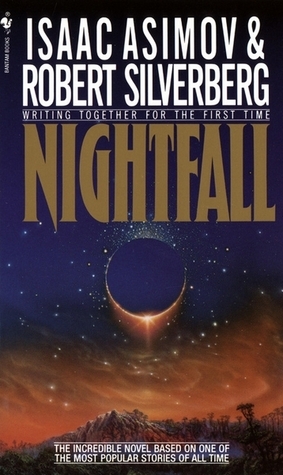
It seems like a good premise at first, but as soon as it was expanded to this length, padding was inevitable.
The premise does not hold up to scrutiny within the world created by these two authors. I am always cautious when grandmasters of sci-fi feel the need to collaborate on a project. Most of those projects seem half-baked. I recall the second Rama book and other poor examples.
On a planet surrounded by 6 suns, the inhabitants never experience darkness. Except for once every 2500 years. This darkness induces madness in them since they have no adaptations preparing them for it. Civilization must start over with every cycle. This recalls things like the Kalpa in Indian philosophy, the cycle of rebirth, the legend of the phoenix, and the legend that there were great civilizations on earth before recorded history.
Studying a little bit about how solar systems are formed would tell you that a planet located in a system with 6 suns would have basically no chance of being habitable. You could argue that the inhabitants are not human, and we should not measure their survivability by our standards. However, they act exactly like humans. Nothing about the characters strikes me as particularly alien. They have developed quite a few useful technologies and live lives very similar to our own. The first thing that doesn’t make sense is the level of technology they have developed.
They calculate with a supercomputer that an eclipse is immanent. Getting to a supercomputer requires quite a few preliminary inventions. These people are sophisticated enough to get that far, about as far as humans have in Asimov’s time, but they are still unable to adapt to darkness.
They even do darkness trials, using the stupidly named “tunnel of mystery.” This short experiment induces madness.
I have a question though. What about if someone closes their eyes? Do they go mad?
What about blind people? If you live on a planet with 6 suns there have to be at least a few blind people.
We are also ignoring the fact that UV radiation from so many suns would sterilize the planet. Not only that, but solar wind would strip the planet of its magnetic field and atmosphere. The tidal influences would cause the planet’s tilt and orbit to be subject to life-ending cataclysms. We are supposed to believe that a non-luminous body is going to cause a total eclipse when only the smallest sun was in the sky. This stretches believability. If the 6th sun was small enough in the sky to be blotted out and reveal the stars for the first time, that smallest sun would have to be small enough to not cover the entire planet with sunlight. You are forgetting that the planet has two sides, one facing the sun and one not.
You simply can’t make this premise believable.
This would all be beside the point if the plot, characters and writing were top-notch, able to carry the reader’s interest. Unfortunately, most of what happens is predictable. The characters act in very infantile ways. They don’t understand themselves, their capacities, and they suck at historical research and scientific method.
I could blame this on Silverberg with his seeming shoddy understanding of science, though I also have problems with Asimov’s weak scientific justifications in his fiction. In short, they are not trying hard enough with this novel. For instance, carbon dating is not accurate enough to get within 20 years as they claim. Perhaps with future technology. But how are these characters using such sophisticated technology in the first place? If humans had never had telescopes, had never seen stars, they still would be operating on a geocentric model of physics. We would’ve had no reason to question such a model and no means of testing it until we launched ourselves into space.
Their theory of eclipses would not be testable or conceivable until they located the phantom planet.
They have supercomputers but their fear of darkness and methods for combating it seem childish as portrayed in the book. Darkness would be artificially advantageous in some cases, part of their survival. Humans need sleep. Do they not close their eyes? They would not have left all caves unexplored, especially for mining purposes to build their civilization and acquire the fuel they needed.
The idea that civilization is subject to a Great Filter is haunting though.
There are many proposed great filters in the universe including the collapse of the wave function in Hilbert space and alien overseers, to the wrath of God to humans discovering nuclear weapons. It’s a concept which deserves serious thought and investigation.
We underestimate the value of being able to see stars in order to do astronomy. Most, if not all astronomical observations of importance were done at night. They would therefore have no understanding of how the suns moved. Ancients believed that gods were pushing the celestial bodies.
On almost every page I took issue with the lack of science in this tale, which was distracting. Nothing else about the book rose above mediocrity. The narration, dialogue, scenes, and setting wouldn’t have entertained me even if I were in elementary school.
I can see how this would work as a short story. Definitely not as a novel.


Leave a Reply