
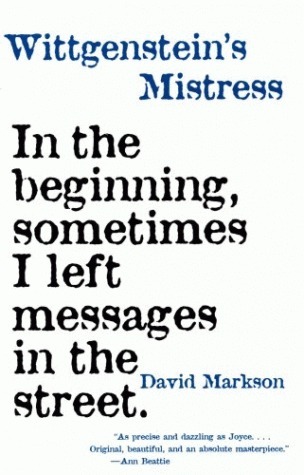
In a world where time has ceased to matter, the main character wears 17 wristwatches.
She is preoccupied with the watches. But she does not explain why she needs them. She can appreciate irony.
In my opinion the book works a lot better in audiobook than it does in paperback. When I tried reading it with my eyes I grew bored. When I plugged it into my ears I was entertained. This is probably the inverse of what would happen if I studied the work of Wittgenstein more.
Where readers have in the past complained about the continuous mention of menses in the book, I took it to represent another form of time keeping. The main character does not know how old she is, and she follows her body’s cycles, is a slave to its demands for food and water. She remarks how beautiful a thing it is to be able to drink any water which is just lying around. This is one of the hints we repeatedly get that there are no other people. Presumably, whatever apocalypse happened left all the canned goods on the shelves for her delectation.
She circles back continuously to the event where she hurt her ankle carrying a massive canvas down the stairs for no apparent reason. She then inhabits a wheelchair on her jaunts through the museum. A few upendings happen throughout her nomadic existence, including a car crash where she ends up dunking the vehicle in water, so that she ends up on the roof of it. To me, this signifies a turning upside of her conceptions of the world. She has stumbled into this mode of life. There is no perfect explanation for why things are the way they are. One is reminded of the state of the universe, of life on planet Earth, which is not always agreeable, but we must make do. Things go ass-up sometimes, and we must get back up.
Her appropriation and appreciation of art is significant in a world where art must needs lose meaning as it loses its audience. She is the sole person to apprehend and define its interpretations. In some cases, she consigns the frames to flames, like she tosses the pages she’s read into her bonfire. This represents the disintegration of her memory and the disintegration of her framework of the world. The destruction of her house by fire, is also a wholesale annihilation of her memory. Without warning, she forgets things, and must accept that fact. Like a house burning, her interior landscape falters, slowly disintegrates. So many things in this book disintegrate.
David Foster Wallace’s astute Afterward points out that the world represented in the book is a physical embodiment of Wittgenstein’s philosophy. Words and concepts take on meaning assigned by the only consciousness left to process information into meaning. One could say that we each, as island consciousnesses, define the exterior universe through our manipulation of language. Language is a tool for understanding the surroundings, of processing it, the way one processes food, which is to say, enacting our will upon it, consuming it, converting it into energy.
So she finds meaning in the dispersal of connections. By repeating the mantras and facts she has compiled, she defines her own limitations and probably drives herself mad. She admits to being mad.
If you are the only one left alive though, can you truly be considered mad?
She regales us with examples of other artists and philosophers who have gone mad. Nietzsche, Maupassant. She laughs at them while her sanity unravels.
She assigns special significance to the soccer jersey, again, when clothes should lose their purpose. The main character lacks modesty. Who would she aim her modesty at?
God seems peculiarly absent from the narrator’s world, uninvolved. It is a self-created world. She is the ruler of a worthless kingdom. Her reign is a mere puttering about.
Troy remains one of the centra themes, its smallness. It represents how history diminishes as it becomes real. How history always inflates its subject. How history is the only way to depict humanity’s struggle for meaning, for immortality. What would be the purpose of her paintings, hung next to the masterpieces in the museum, and her writings in the sand, and her memoir which the reader must endure, if it weren’t for a reduction of history into a discrete packet representing a personal vision of history, how it has congealed into this singular person, left to wander among the dregs.
I am reminded of the trend in Russian fiction where many authors wrote various takes on the ‘diary of a madman’ routine. Gogol, Turgenev, Dostoyevsky, Andreyev. Then you have other versions like Akutagawa’s and scarcely veiled ones by others. The diary form shows the disintegration of parts of a personality well. It is coupled with an intimacy. A fascinating approach. But Markson takes it further. The book is a journey, and a scattering of interior facets. The narrator wishes to leave a mark, even if it is a smear, upon the face of a desolate world.
I would’ve liked more post-apocalyptic scenery. It was a cozy end times, like the setting of some mangas I’ve read – think YKK. I would’ve liked more signs of other activity. Perhaps some ghosts she could not fathom, infringing upon her endless summer, her petering out.
The way she points out the flaws in her own language but misses the glaring factual errors she spouts off shows that she is concerned with the granular nature of her thought processes. The articulateness matters more than accuracy. Language is how she constructs reality, kind of like our pal Wittgenstein. But language can betray us. The grammar’s construction can rearrange in the atoms and reshape the experiences we absorb. We take in literature, art, media, and expel what passes for a personality. We fashion our interiors by appropriating the badges of heroes, the tattered remnants of what we’ve read, by picking up the scintillating coins of thought from the studio floor.
I might compare the book to Piranesi, which I recently read. It also depicts a landscape of the mind projected outward. It recounts a fantastical version of a Borgesian ideal.
One might ask, our world is so rich, what need have we of abstraction. However, humans are geared toward fruitless spinning out our daydreams. We live in the mind, while we merely inhabit the world.
We are all subject to a final disintegration. Memory often departs first without so much as a by-your-leave. It leaves us drowning in a world of stimulants. Memory is an intellectual’s dearest friend. But that betrayal is inevitable.
It is a book about aging. An aging of the human race. Our new Eve is a scatter-brained brainiac. She loves the philosophy she has not read. The idea of philosophy is always more compelling than the philosophy itself.
The aphoristic style is in line with its referent subject matter. The short paragraphs create dislocated moments of time, atomizing information. The style is perfectly apropos.
Her concern for other cultures precludes the current existence of other humans. Prior existence is all that matters. She is none too concerned about the future.
She feels the need to justify what she is saying. Explaining to the reader what she means in every other instance where multiple interpretations could sprout. By this she creates a faith in a readership.
There is no reason to believe humans will persist. How is she to reproduce? However, she trusts that someone will read her work and require clarification on the simplest and silliest of points.
Her reading is a means of tearing apart reality, of converting content to memory, which is more portable, but unreliable in the long run. Only hard media contains unsullied realties. We must impose ourselves upon art pieces.
Undoubtedly a masterpiece of sorts, but a very repetitive method renders it passingly enjoyable in the same way less-dense philosophical enquiries can be.


Leave a comment