

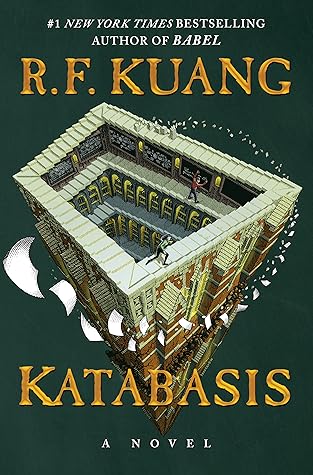
The comp titles got me interested.
But in the end, I was disappointed. As in her book Babel, the author changes the driving force of the novel midway through. The narrative becomes a vehicle for political statement. The references to mythology are shoehorned in, in my opinion. Like the expected Biblical references in Babel, they were more there for checking the box of literary relevance. What she really wanted to explore was her magic system.
The thrust of this book, it seems to me, is relationships.
The scenes are typical of genre fiction. The essayistic asides are long and indulgent and more academic. Not really related to the character interactions most of the time. Sometimes they will casually drop names of alchemic texts and world-building elements, but the issue of the premise held me back from enjoying most of the story. The educated characters bring up philosophers often to seem cultured, to act knowing. Our main character wishes to be in control. I would’ve liked to get her backstory in the beginning, instead of most of the way through the novel. It is the same as asking the reader to trust the author for hundreds of pages, following a character with tenuous motvation. There is an air of elitism here, as in the previously mentioned work, but this is spoofed when they meet the academic shade. Considering that the author got advanced degrees at Cambridge, Oxford, and Yale, (only so she could write fantasy novels?) I shouldn’t be surprised she makes fun of aspects of academia, though she relies on the tropes heavily.
They enter a very tame version of hell. Very amicable. Cozy. Ultimately unconvincing and mostly uninteresting. After reading other books in the genre of Katabasis, I would not rank this above Larry Niven’s inept rendition.
The main issue is inconsistency. For instance, reincarnation is confirmed in person, in Hell, but speculated about in the literature connected to the world building. They can’t come to a consensus in the living world what form the afterlife takes in this novel, but they make plenty of assumptions while in Hell. They don’t know seemingly what is easy to find out.
Mixed mythologies interrupt my enjoyment. A shallow reading of Dante would yield greater riches.
The shades are supposedly eternal but waiting for their next life, The reasons for not moving on are ill-defined. Why do shades get to choose their fate? Why does any of this exist at all in the world of the novel?
The way the male companion tiptoes over her feelings really annoyed me. Not only did it strike me as unrealistic, the niggling attitude he takes toward her, rendered the ruthlessness with which he was later depicted moot.
If it was so easy to get into Hell, why was the literature on the subject so scanty and unhelpful? I understand their is a heavy cost to summoning the portal, but that is so easily invalidated that made the entire journey seem like a cop out in the end.
The suspension of disbelief was impossible to get over. Why would they give half their lifespans to get into hell in the first place? Their motive makes no sense, even when you factor in the later revelations about their professor. Their half-baked plan was pathetically inutile. Like other works in this genre have no idea how to exit the underworld. It is only interesting if they find out likely methods along the way. But the author is more interested in cataloguing their social cues, rather than making sense of the world building.
The pseudo romantic tension took up too much time.
Their reverence for their professors was disproportionate. I had to take the author’s standpoint as facetious. It was either that, or insane, to consider a professor’s esteem and respect worth dying for.
The college setting felt small-minded. If this is considered Dark Academia, I am probably not the right audience, since I found similar problems with the work of Donna Tartt.


Leave a Reply