
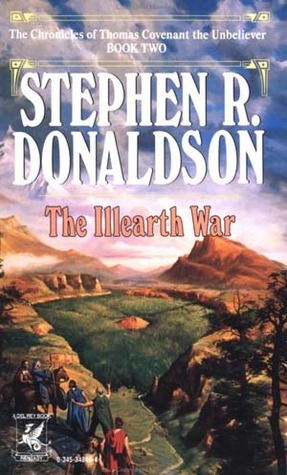
This return to the world of the first book was consistently engrossing.
Probably my favorite aspects of the series are the descriptions of The Land. In countless lovely passages the author showcases his exquisite command of landscape painting with words.
The place is characterized by the profusion of natural splendor, and the way it is suffused by magic.
What Thomas Covenant does in the real world damages him physically. What he does in the Land damages him psychologically. He seems not cut out for either place. He is healed of his disease each time he comes to the fantasy world. And his delusion is dispelled whenever he returns to his miserable life.
The first section of the book, where he returns to his sad existence was moving. The treatment he receives and his self-destructive despair were compelling enough to justify their inclusion. the explanation for how he gets to the Land is typically flimsy. We are meant to surmise that it is a dream. But it is too profoundly real and complex for that. It makes him doubt the reality of his former life.
This mentality shifts when he meets Hile Troy, who appears to be from his world. Another sojourner in the Land. Similarly, this man has been cured of blindness and handed an important destiny on a platter. The Land has a way of bringing out one’s true potential, no matter how buried it is. Thomas remains the gravest inhabitant, perpetually in doubt, and confronted continually by the troubling rape he committed in the first book. The consequences haunt him here in more ways than one. He must reconcile with his weakness, his worthlessness and step up. Readers will be as frustrated with him as they were in the first book. But that’s the point.
His argument with Troy about accepting responsibility for his destiny and the way they debate whether the whole thing is a dream, showed that in both cases, action needed to be taken. The Land is dying under the sway of Lord Foul’s armies. The good people under siege have failed for 40 years since Thomas’ departure to secure a foothold. Again, he is their only hope, though now Troy will play a major part as the commander they sorely need. Shrugging it off as a dream is a cop out which will cost them everything.
Being in the Land, strengthens Troy’s sight and empathy. It magnifies his powers. We have a responsibility to live meaningful lives. Everyone who came before has paved the way for Thomas. “The dreams of men belong to God,” Troy says. Thomas has been chosen. Our main character persists in his naivety and Troy is forced to take control of the narrative.
Huge portions of the book are taken up by discussion of the strategies employed against the enemy. We then get to see these plans come to fruition or fail. The battles are immense, epic, fraught with luscious description. We can recognize this style as Donaldson’s trademark. The whole purpose of the book seems to stage these grand operas of blood and carnage. The Land participates in the bloodshed. These characters are like microorganisms swarming upon a vast living thing.
Thomas’ answer is: “He should leave living to those who were potent for it.”
Till the end, Thomas again shirks his duty to his people. He wallows, he laments.
All the while the Land seduces. It persuades him to let go of his pathetic image of himself. It constantly reinforces and exerts its own reality.
The Lord’s table is round. The Lords war with one another like knights.
Thomas holds the ring of power – an on-the-nose reference to Lord of the Rings.
The enemies of light want him to deny his involvement. Lord Foul’s reaches go deep, infecting his resolve to rewire his destiny.
The dark one gasps at our humanity, squeezes the love and abundance from our hearts. We are left as husks, as cogs in a destructive machine.
The author’s vision is at times mesmerizing. The world-building boggles the mind because it is presented haphazardly. We are meant to intuit the hierarchies of this military campaign without the help of interiority. The book demands attention, but it rewards with enjoyment.
 L. S. Popovich
Leave a comment