
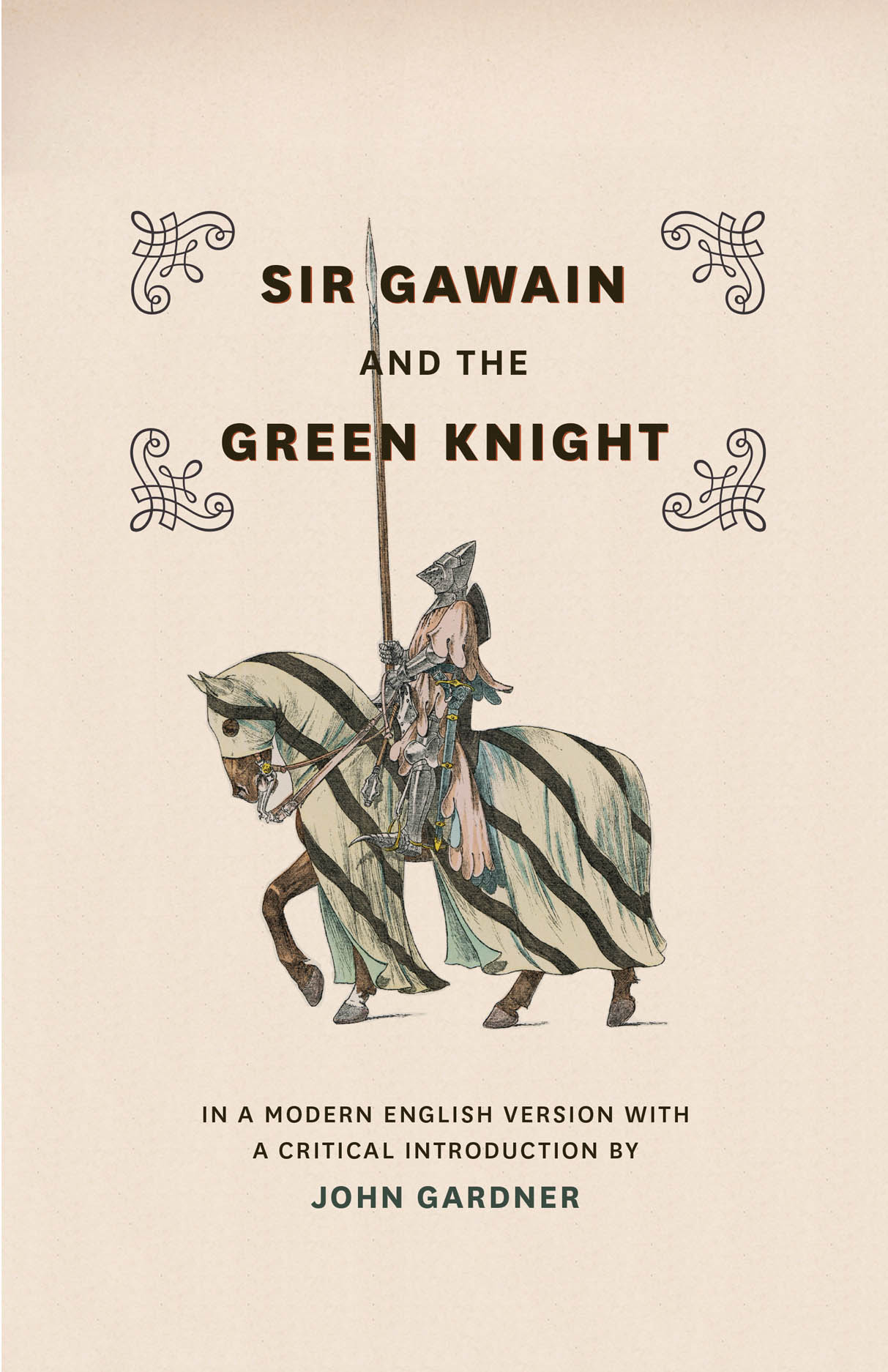
A great poem of Medieval times.
Along with Beowulf, a fantastic entry point into Middle English texts and classics in general.
The poem works on multiple levels. Some nuances require a little effort to parse, and knowledge of context. Several editions I’ve seen contain helpful notes.
Gawain starts out as a pseudo member of the round table. Arthur’s dinner sets the stage for the entry of the Green Knight. The descriptions of the knight are lavish and alluring.
Gawain gets caught up in the contest with the knight and must go on a journey.
Interestingly, as he sets out, a year has already passed since his promise to the court and knight to fulfill his duty. This has added to his fame. But he has not yet proven his worth.
He has lived a year with the suicide mission he must undertaken hanging over his head.
We are told he goes on many adventures on his way to the Green Chapel, but we do not get to hear about them in this poem. The plot resumes when he goes to the estate of Bertilak. This is a perfect place to shirk his duty, to forget about honor, to rest and relax. This host is far too accommodating. His host is a test as to whether he will have the wherewithal to continue his quest.
Gawain enters the castle. Is received with enthusiasm. Is asked to participate in a Christmas game (echoing the Green knight’s challenge). Bertilak goes out hunting and Gawain stays in the castle and what the hunter receives he must give to Gawain and what Gawain receives he must give to his host. Like the Green Knights challenge posed at the beginning, the contest seems rigged in Gawain’s favor, but it’s really a true test of his virtue.
Over 3 nights Gawain is almost seduced by the wife of his host. She first gives him one kiss which he must return to the host. Then two kisses on the second night, which he returns to the host. She tries to go all the way with him on the third night but he refuses, she offers him the green sash as a consolation prize, which will protect him from harm. This he accepts instead, knowing he narrowly missed sinning big time with her. Instead of giving this prize to his host he gives three kisses to his host, so breaking his oath, in a sense cheating.
Next he goes to the green chapel, and The Green Knight is can be interpreted to be Bertilak, chastising him for not fulfilling his vow.
Kinda creepy but makes sense.
The film doesn’t quite capture the game being played in the poem because the castle contest isn’t as explicit.
So the green sash is why he is chastised. The short cut that he took. Inexplicably, in the film, The Green Knight, he’s given this sash in the beginning by his mother, and then receives it again from Bertilak’s wife after bandits had stolen it.
The entire story is one big game. I think the movie captures the tone of the dire stakes involved.
But while the point of the original is how even the best of us can’t compare to Christ the movie is concerned with what makes someone a knight. What knightly qualities point toward the creator. So taking out the Christian theme in the movie probably left the film feeling slightly empty. I got the sense more that Gawain was simply seeking glory.
Gawain was still tempted, and resisted, but he did not reach perfection. Even as he submits to the blade.
The point of the poem is technically that Christ’s perfection is unattainable for man but knighthood and its tenants are the closest a man comes to christliness by exemplifying his virtues. This is reinforced in the structure of the poem, which is 101 stanzas, which represents the imperfection, the closest point to perfection a knight can attain to. 100 is the perfect number. A knight may reach 101, greater than a man, but not perfect.
The movie sort of shows that the game is a test, but it gets distracted by giants and a talking fox.
The poem excels at describing the brutality of killing the fox. It’s a false foreshadowing of what could happen to Gawain.
Like other modern films, it uses the name recognition of the classic to push another message rather than sticking to the source material. I can place Wuthering Heights and Inferno in this category. I can only hope that Nolan’s upcoming Odyssey film doesn’t do this.
Medieval books go heavy on religious allegory, but the Gawain Poet (as he is anonymously known) is very subtle in his use of the theme. The language is multilayered and the structure is purposeful. The ambiguity inherent in the poem is in part captured by the adaptation.
Grendel by John Gardner suffers from this issue as well. It could have been a masterpiece. A retelling that adds more layers to what the author was trying to say and do with Beowulf. It’s not just a story about killing monsters. It’s a story about how to live and how to die.
But the author threw in post modern philosophy and nihilism. It does not honor the subtext of the source material, the main concern of spiritual growth that fueled the original.
Post modernism seems more concerned with iconoclasm and nihilism. After the World Wars, it seems
Literature shifted to social themes and became heavy-handed. Finally, free love, New Atheism, and other movements really spread secular lifestyle as the hip and intelligent lifestyle, and literature followed suit to the point where religion stopped being even mentioned by most authors. It became not even a rejection of religion but an absence, something authors can’t touch because they are scared of social perception.
But a lot of artists are not consciously doing it because have zero curiosity about religion, and take the spiritual realm out of their fiction. This dimension of spirituality can help characters feel real and make the changes they undergo more meaningful.
Great literature, like Beowulf, engages in an exploration of the spiritual side of mankind. That is something I wish more modern novels would do.
 L. S. Popovich
Leave a comment