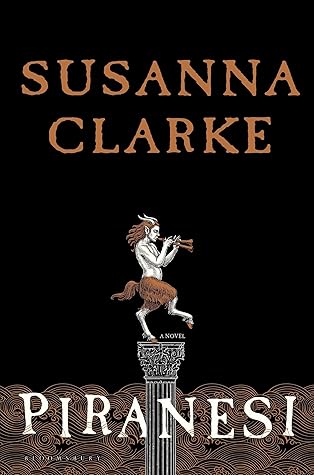
I will argue that this is one of the most interesting books ever written.
One of the best I’ve read. Below is a portion of the notes I took while reading it. I actually had to discard a large portion of the notes by the end because the book recontextualized my understanding midway through.
It is a good indicator when I want a book to be longer that it will become one of my favorites, a five-star read, and one I will revisit.
Piranesi inhabits a well-realized world that extends far beyond the confines of the novel that describes it.
The characters take the House in the novel to be infinite, so the reader must assume that it is, though there is no evidence that it is. It is simply too big to traverse on foot. One wonders if they transported enough materials into it to construct a hot-air balloon, if they could map out its extent.
The House mirrors the human mind. You only ever see a small portion of it. Only a piece of it appears alive at once. The rest lies unperceived, seemingly asleep.
The House is uncorrupted as conceived by Piranesi.
Raphael mentions that corruption has entered the House as murder and deception. If only Piranesi had inhabited it, it would’ve been free of human nature’s inevitable self-worship and selfish, destructive tendencies.
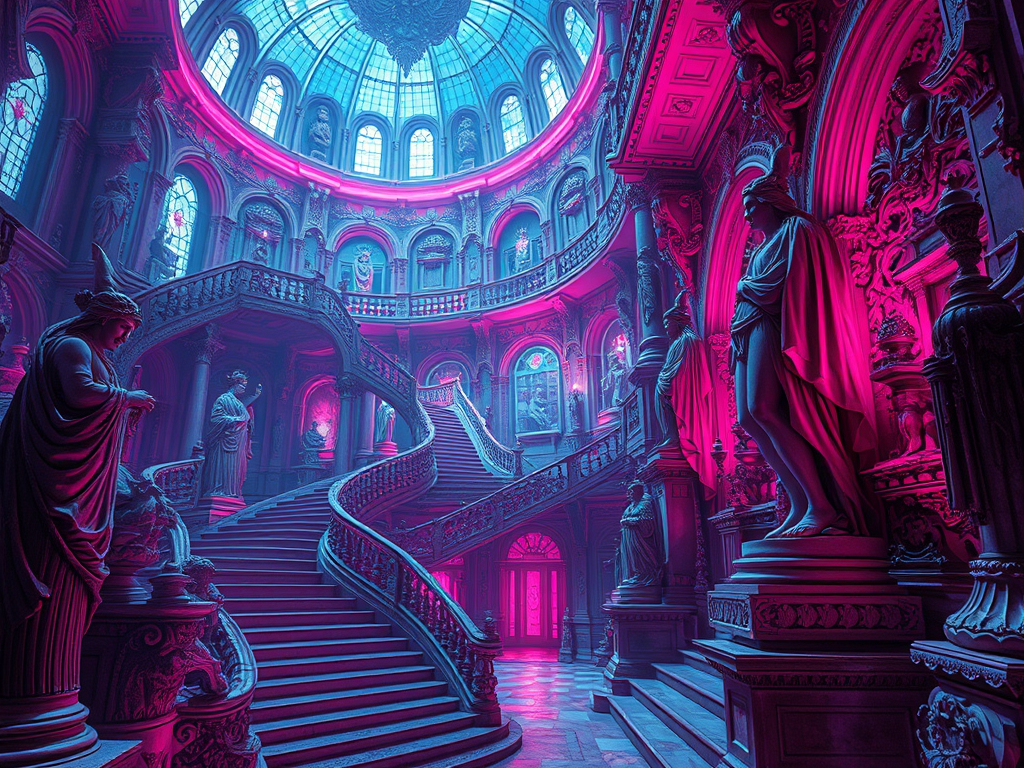
The architecture is non-repeating, composed of stairs, corridors, rooms, and ornate statues. There is an order to it, though its mathematical variations in size and shape would probably defy conventional uses.
Piranesi’s discovery of the truth, or knowledge of the real world, induces trauma in him. True, knowledge can be traumatic. To him, the real world is the House and that other world, the world of men, is a deception.
The tides are predictable. He has worked out their rhythm and currents; however, he cannot foresee the dimensions and layout of the House. The underlying pattern is too complex for him to fathom, or it is too elusive, too abstract to calculate through his arduous exploratory methods.
The statues are the most interesting aspect of the House. There is an alarming number of them. Each seems to suggest a narrative. They are interpreted by our guide, Piranesi, who imposes on their mute display certain fantasies and arcane meanings. This indulgence in the occult subtext of the statuary is a remnant of his involvement with the occult group of self-proclaimed scientists who discovered the House. Yet, his ideas about the meanings of the statues are touching and relate to his innocent misapprehension of the operations of the world. Humans are mythical to him because they are so rare in his memory. The statues are his models of humanity.
The Hall of Minotaurs is mentioned most often as a crucial point, but the House does not seem to favor it. If the House is conceived as a consciousness, it lacks an ego. It does not exert its existence. It will continue to exist if no one is there to see it.
Piranesi’s main frame of mind is reverence. His behavior is characteristic of someone who builds castles in the sky. But he gets to live in them. He is uncontaminated until his precarious situation is upended by the behavior of aptly named The Other.
At the same time the House is clearly a prison. Our narrator retreats from reality because he is enamored with his house. One thinks of Jean des Esseintes, a reclusive aesthete from Against the Grain.
The prison is built by someone else. It is an allegory of narratives imposed by others which become architecture constraining him.
The Other exploits the labyrinth as he exploits everyone he knows. He never explores it. He is ignorant of its beauty, sees it only as valuable experimentally. He is interested in how it can empower him. Piranesi exists within this false narrative.
Piranesi’s amnesiac past propel the novel into Mystery territory, as he works to unravel the conveniently kept journal entries which provide the extensive exposition in the novel.
90% of the book is telling, told through journal entries. We get commentary by Piranesi and later, scenes with other characters. It is frozen in his perspective, which introduces the reader to his unnerving predicament, but also creates tremendous dramatic irony since we are trained to detect the duplicity of others.
His identity was reformed around the House’s limitations. He had no need for certain concepts, so they evaporated from his memory. The Others seems eternally fascinated by this debilitating process in his pet experiment, Piranesi, whom he has named, mockingly after the famous architect. It is a fitting nickname, but our main character cannot help but assume it as his only appellation. He conforms to The Other’s definition of reality.
The quiet abuse at the heart of the novel proves to be the germ that destroys memory. Piranesi’s life is rewritten by himself. He must live in this dream because he cannot bear to let its grandeur go unobserved.
Ketterley turns out to be part of a cult. They enact Magus-level rituals, and give sacrifices. It is posited that they accessed the House, not that they created it.
The lower portions of the House, full of water, relate to Nigredo, where dissolution of identity reminds us of the id. These contain submerged statue giants crusted over with sea-life and coral. Animal life, birds, and seaweeds flourish in the House, where humans do not interfere with their life cycles. We do not know how deep the lower portions descend.
The ground floor sections can be called Albedo, symbols of clarity. It contains more grounded, relatable statuary. Our hero draws the most meaning from these areas.
The upper levels are the domain of the birds, you could call them the Rubedo.
To restore and understand himself, Piranesi must traverse all levels of the House. The higher reaches are his salvation when the floods rise. The lower levels provide his sustenance.
It could be surmised that attention creates the world. Maybe it lies in a superposition of existence and nonexistence until someone examines it.
The narrator’s endless recording of the surroundings is his way of personifying the House, of rendering it comprehensible. To him, it is a god, the creator, and he is attempted to compose a scripture.
The Other sees the House as opportunity, resource, notices nothing of its aesthetic immensity.
Piranesi is the only one who adapts to the House, without expecting it to adapt to his presence. He learns to feed himself and collect water and navigate, unlike the other humans who cannot live in the place.
But is his wonder an adequate form of knowledge? The other form of knowledge he encounters, the Truth, leads only to his misery. But he decides it is better than living a lie. By freeing himself from the Other’s tyranny, he learns to enjoy both worlds, but he is fundamentally less happy in possession of his memories. Ignorance is bliss because we can attribute gratitude to our daily reverence of the natural world instead of the inane machinations of narcissistic humans.
He loses the sacred when he discards his ignorance.
The House becomes a Paradise Lost.
The broken statues are signals of his trauma. He feels always that the statues are telling him things. They are in league with the birds, who rest on specific statues to send messages to him, he thinks.
The Fall of Eden is depicted in the entrance of a deceiver and the actions of human nature intruding upon the natural order.
Like Adam naming the animals, Piranesi categorizes all the beasts, fish, birds, and statues.
When he recovers his past, he is expelled from his former state.
The ending is one of reconciliation between his relationships with the two worlds.
The Other seeks magic power, which he calls secret knowledge. The abilities he describes as latent in the House or the strange constellations above it are all self-serving. He mostly wants to subjugate lesser minds.
This mirrors how authors have used myths as models for their work. Clarke is standing on the shoulders of Milton and Borges and others by crafting this world. We have been gifted knowledge by the ancients, and we inherit their power.
But these same powers can often be our undoing. Truth remakes a person.
Piranesi exists in a state of madness that is superior to sanity. He is a mythic assimilation. He entered the tale so fully that it reshaped his identity.
Is harmony really possible between the two worlds? Dipping in for quick visits seems to be a new pastime, though I really wished the ending had been more one-sided, with him returning to his amnesia by choice.
Piranesi is not interested in revenge on The Other. He is too pure for that. The world is brutal enough without him adding sin to it.
But he refuses to give up either of the two halves of himself. At least Raphael understands him for who he is and what he’s been through.
The book suffuses many more themes with psychological and mythic references. It is one of the great novels of architecture. It contains multitudes of hidden messages and is open to many interpretations.
Are the statues a Jungian pantheon? They seem to be a fossilized collective unconscious, frozen archetypes. The author describes them with loving detail. They are some of the best passages in the book.
Piranesi attaches dreamlike significance and prophetic meaning to each one.
The woman carrying a beehive is a nurturing symbol. Reminds us of fertility, organization, hive culture. Piranesi is a caretaker here, a gentle presence.
The faun with an apple is similar to a scene of temptation. The faun is half animal-half human. It is an Edenic creature. It contains a dual nature.
The statue with water flowing from its hands. We can take this as renewal. The refreshing of the tides, the ebb and flow of memory.
the child pointing is a beckoning to Piranesi to venture out and discover. To leave safety and come back changed.
The statues are internal as well as external. They are pieces of his soul.
Memory acts like tides. Fragments float through it and sink to great depths. We must dredge up the past.
The flood is an advent of trauma, when he must transform from his innocent state.
Even after he awakens, he still believes he possesses two identities.
Knowledge is often describes as a series of rooms in the head. The brain is compartmentalized.
Piranesi, the Italian artist used impossible architecture in some of his pieces.
Amnesia is a side effect of traversing the labyrinth. The Other believes that Great and Secret knowledge waits to be unlocked. He does not thereby earn knowledge but steals it. Piranesi trades his humanity for knowledge of the labyrinth.
Every labyrinth has its minotaur. I see The Other as the Minotaur. But we also have statues of Minotaurs which line the corridor which connects to the outside world. They are gatekeepers.
The maze protects Piranesi while it consumes his memories. In Egyptian mythology there is a twelve-hour night journey in the Amduat, wherein the sun god goes through chambers guarded by statues. The journey has sequences. one must confront the self in various forms, manifested by violent statues.
Piranesi is also good at dissociating. It’s a common way of dealing with trauma.
I didn’t like how the journal entries which provided the knowledge he needed were mostly available to him. He did have to recover some of them in fragments after they were torn out. We are left to wonder if he tore them out himself to further bury himself in the illusion or if The Other tore them out to manipulate him more effectively.
The way he cares for the bones of Ketterley and the others shows that he is moral, selfless. He is in tune with the sacred.
The liminal zone aesthetic here is the best part about reading the book.
Raphael is like Ariadni. She guides Piranesi back from being lost in the maze. The Other remains imprisoned in the House in the end because he used the place as a prison all along.
Even while in the outer world Piranesi compares people, he sees to statues. The statues seem to be versions of real people transferred into the statue-world, we are led to believe.
The House may be an abandoned cosmology. It was not created by humans so it is by definition divine. It is like a heaven for a certain mindset.
It is a realm of forms -a concept put forth by Plato.
The German philosophers also posited a realm where ideas are given form. They do not simply disappear, as the one called The Prophet remarks. abstract concepts take shape in a separate reality. Here they persist forever.
Catherynne Valente’s novel Labyrinth contains shades of this novel’s concerns. One is also reminded of Milton and Dante. This is a mythic journey. You get a lot of imagery like in Ovid’s Metamorphosis.
The perspective reminded me of the miraculous novel I Who Have Never Known Men. All of these books are on my favorites list now.
Over time Piranesi’s clothing fades. All the colors become gray. He could be said to transforming into a being more akin to the statues.
His knowledge of the maze is a survival trait yet it is innate. He behaves like an animal, acting on instinct.
I wondered why Piranesi was so naive in the beginning, why he thought The Other was incapable of lying and why he did not question the Other’s immaculate clothes. He didn’t wonder where the items he was gifted came from, how they were manufactured or what The Other dead when they were not together. He does not question the light-up device the Other blatantly uses which is obviously a cell phone. The situation may be frustrating for some readers but the set-up is necessary to establish the unreliable narrator.
Piranesi learns about social cues from the statues but he is constantly fooled by the Other’s simple lies. He begins to see the holes in The Other’s narrative and it is highly satisfying.
The Other’s abortive quest to attain alchemical immortality is foolish. Piranesi wonders what would he do with it?
At first the narrator’s behavior might be described as neurodivergent, but it is a clever ploy on the author’s part to manipulate the reader’s expectations. the Other’s deadly serious attitude is his undoing. To Piranesi, the House is like a game. His childlike wonder is constantly appealing. The House seems like a superorganism. It is like a beehive, a well-ordered form of chaos.
Piranesi prides himself on his powerful memory, but that is pure irony.
The search for Great and Secret knowledge is being undertaken by Piranesi and The Other Simultaneously as well as the reader. But all three searches take different forms. All three are looking for a different form of reality.
I think I have made my case as to why this is a great work of literature. Yet I feel there is much more that could be said about it.
 L. S. Popovich
Leave a comment