
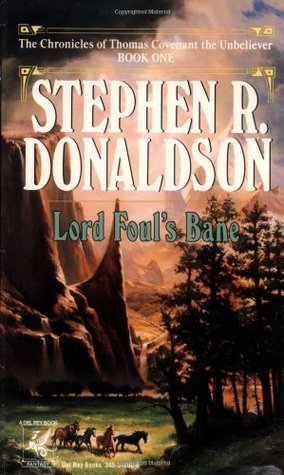
A complex work of epic fantasy.
The first of nine books taking place in the Land.
Its clever structure and unconventional aspects were a plus. Many people hate it for its main character. But an understanding of the text justifies the protagonist’s behavior. An examination of his motives and reactionary feelings will explain his issues.
It took me quite a while to get into it. I have to be in the mood for epic fantasy. My reading goes through phases. Now that I finally finished it, I foresee I will go through a long Donaldson phase.
This type of nostalgic fantasy makes use of plenty of quaint world-building constraints. It resembles the Tolkien model in its sweeping, adventurous spirit.
We begin with an unwilling anti-hero. A leper in the modern day, shunned, cursed, and indignant. When he ventures out of his sanctum, he hopelessly falls in front of a police car and is transported to another world. These details are significant. His outreach is a plea for help. He suffers from self-destructive tendencies throughout the work. The police, a symbol of order, cause his distress and reinforce the excommunication he suffers in his town, where before he was a respected community member.
Once in the Land, as it is called, he becomes a reluctant participant and a conscientious objector to that world’s problems. The isekai setup flows into a chosen one narrative arc, but not before he exerts his will on others, including raping a woman who sought to help him. This heinous act haunts him throughout the rest of the novel and into the next. Since his wife left him due to his disease, he became resentful, perhaps toward women, but also toward his impotence to change his fate. He continually refuses to buy into the fantasy and counteracts the efforts of the quest building around him. He is not cut out for this. After living as an outcast, he can’t stand being the center of attention.
The Land is his testing ground. Will he rise to the challenge? He meets many strange creatures and sentient beings. Most are in thrall to Lord Foul, the obvious stand-in for the devil. The themes play out like a typical pulp epic fantasy from there: creation and desecration, healing and corruption, perversion of innocence, gasps of desperation, the burden of loneliness, vindictive cowardice, self-serving instincts, and the fulfillment of prophecy. Many of these mirror his struggles in the real-world of which we only get glimpses through his interiority.
The white gold ring is his source of power, a mere wedding ring which followed him into the fantasy world. It represents his sense of self-worth too, after the bitter ending of his marriage and the onset of his chronic hopelessness. He holds onto it with no assurance that it will save him. It inspires immediate trust in those around him. There is no question in their minds that he is the legendary hero Halfhand, who is supposed to relieve them of their distress. The fingers he lost in life to his disease are a mark of honor here. There are many such reversals in the book.
Yet he does not understand the ring’s power, using it only at the end out of desperation, as a sort of deus ex machina.
Even while others are accepting and following him, he remembers his shame. He feels wronged by God, and that spawns a despicable streak in him. Society also did him dirty, and he almost wants to watch the Land burn at moments, deep in his brooding, because he is so hurt. But the Land is his way of righting things, at least in part. Though he is handed the heroic fate, he refuses to act like the conqueror they need. He dwells in his regrets, is living a lie, but in doing so, he reveals his true self to the reader. Till the end, he believes he’s dreaming. It’s the only explanation.
Thomas the Unbeliever, as he is called, is probably a reference to doubting Thomas from the Bible. His constant wandering through a bizarre fantasy land with indulgent scenic descriptions and lavish vistas is the main draw of the book, however. Whether you care about the character motivations or not, you will get plenty of time to luxuriate in faraway places.
A main character who constantly questions his worth and moral imperative can grate on the nerves. The balance is slightly skewed in this first book, but I thought the endless uncertainty of Thomas was integral. By the end, his work in The land as savior is left undone. About a hundred world-building concepts are introduced and touched on with such frequency that the terminology can be overwhelming. The Glossary is also poorly written, almost requiring a Glossary for the Glossary.
More mature than other fantasy series, the vivid, lush and well-realized atmosphere is simply a methodical application of fantasy tropes, with a peculiar perspective, and I would describe it as a joy to read.
What is a man to do in the face of the unnameable weirdness of a fantasy of such vividness except to question reality and his sanity? The ghastly landscape of life is no less daunting for one like Thomas. When he is cured, he cannot appreciate his good fortune. When he hurts others, he does not feel their pain. Numb to everyone, as he is numb to the majesty of the Land.
Through telling details and apt metaphors, subtle observations and emotional scenes, Donaldson succeeded at crafting a memorable introduction to the series. Despite himself, Covenant offers an incredibly rich viewpoint of discovery. The clever, elegiac songs and amusing side characters will satisfy any Tolkien fanatic. The plot is rarely slow. The ending is the only part that struck me as chaotic. The movement and cadence of the language worked in my opinion. The ruination of a pristine land through moral decay, through the workings of strange beasts, was intriguing. This resonation through our main character provides depth and interlocks with the many themes.
Thomas states his feelings when he says: “He had been serving Lord Foul since his first day in the land.”
You get joyous and creative over-descriptions continuously, like this one: “Abruptly, he began to laugh. His glee mounted; It echoed off the cliff above Manhome until the mountain seemed to share his elation, and the infectious sound spread until everyone near him was laughing without knowing why for a long moment. He threw out gales as if he were blowing debris from his soul.”
Finally, the destruction of the land and its corruption is equated to the working of leprosy. Leprosy is the ultimate victor of the tale. It is unassailable. A horrid enemy of life and love and gentleness. It is what Thomas must learn to fight against. Yet it consumes him, mind, body, and soul.
 L. S. Popovich
Leave a comment