
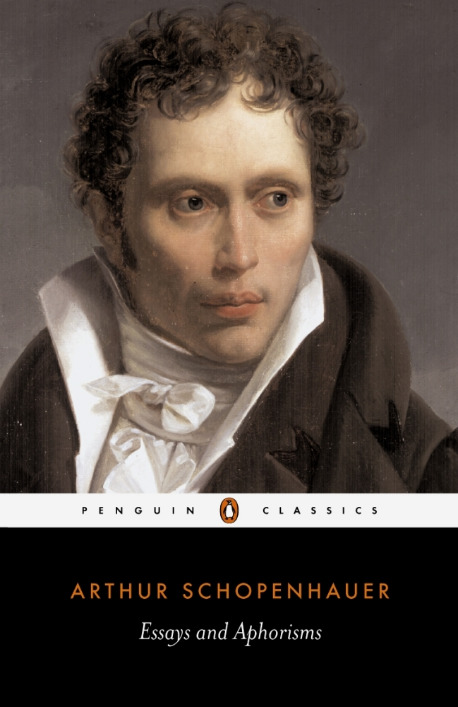
A representative collection of short essays from an intriguing philosopher.
Unlike the other German philosophers, Schopenhauer did not cloak his thoughts in obscure terminology for the most part. He expresses his arguments clearly, with profound confidence. Though he believed in the immortality of the essential being, the will, he took umbrage at the claims of religion, which he railed against at great length.
The indestructible will also represents the personality, which is separate from acquired knowledge. He flat out says the female = intellect, male = will – what is that based on? What does that mean? One can only gather that he had a low view of women, evidenced by his misogynistic essays on the subject in this volume.
A fear of death permeates his writings, like many similar meditations by the likes of Pascal and Camus—despite his injunctions against the fear of death. He argued that suicide made a certain sense, given the inevitable difficulties of life and the supposed comfort of nonbeing.
He supported polygamy and abhorred slavery in North America. The translator describes him as a womanizer, and that behavior is not surprising given his attitude toward that sex.
I was most surprised by the fact that he was influenced by the Vedas. The Upanishads, in some ways, assisted him in crafting frameworks to justify his pessimism.
Unlike Berkeley, he did not hold that the universe was immaterial. However, he divided reality into a duality of will and idea.
He recommends Lessing, Goethe, Jean Paul, Tristram Shandy and Don Quixote as good indicators of human nature.
His interest in the inner life, the way he found value in literature depicting inner action resonated with me.
He asserted that suicide shouldn’t be vilified as a crime, that victims should be allowed a dignified burial, but why does he attach significance to burial when he attaches no significance to life itself?
His concept of will was central to his philosophy, which was set out in The World as Will and Representation. His other books were mere DLC for this towering volume. His conception of ideas differ from the definition provided by Hume. For him, they are the means by which the will is objectified. Humans would fall under this category as well. The Will-in-Itself cannot be represented, but must rather be transliterated, to paraphrase his various illustrations.
Like many atheists before him and since, he hints at a type of eugenics to produce able rulers, and believes that poverty is equivalent to slavery. He believed that the “savages” had no inner life, and that men could not escape their class. His textbook misogyny was a great disappointment. Yet, one need not agree with even 10% of his beliefs or ideals in order to wonder at his eloquence and marvel at his forceful intellect.
“Authors should write for ideas, not money.” That I agree with.
The use of astronomy to detect unseen planets is equated to the connoisseur who detected the leather strap and key at the bottom of a cask of wine—which was an image he stole from Hume’s Of the Standard of Taste.
“The only things worth writing derive from your own mind, your original thoughts, not the regurgitated thinking of other writers.” So he proves his hypocrisy there.
The world of thought is tangent to the physical world, and humans are responsible for transferring information from the latter to the former. This does not square with entropy, though this alternate dimension in which the will abides is no more tangible than the subtracted order to produce chaos.
Schopenhauer’s style is far less demanding than the likes of Wittgenstein and Heidegger, in my opinion. A reader can take part without straining the nerves and one’s capacity to know in the mental life devoted to reflection, which is then reflected in the outer world of the material, and rest easy that one has come out ahead. One must instead critically regard his questionable morals in the same light as Nietszche. Subjective morality does not produce enviable historical situations.
Schopenhauer’s creed may be summed by saying: Misfortune and suffering are the default state of mankind.
He emphasises the fallen nature of humanity. Time as a tyrant. Life as a sentence which must be worked off. He distinguishes between palingenesis versus metempsychosis. His extension of Kant’s philosophy of the thing-in-itself becomes the embodiment of the will. As a mode of synthesizing Kant’s cold scaffolding.
This book is worth the effort for the objective writing style. It will not warm the cockles of your heart but it may enhance your tolerance for philosophic questions and could act as a bridge toward the other German giants of nonfiction.
The most absurd quote from the book is this one: “the beard, being a half-mask, should be forbidden by the police. It is, moreover, as a sexual symbol in the middle of the face, obscene: that is why it pleases women.”
 L. S. Popovich
Leave a comment