
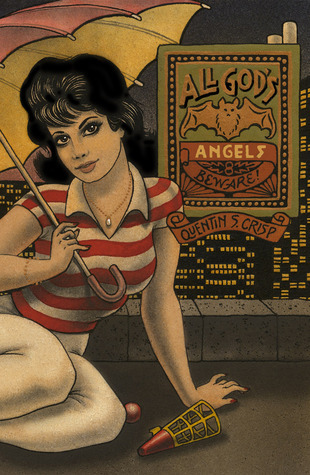
QSC’s output is typically speculative.
His stories do not fit into typical categories otherwise. This rare edition includes some gems.
For the first 3 tales, I was not enthralled. I found them lumbering, dreamy, wistful. They take place in Britain. A lot of the extraneous description and interior monologue might’ve been cut out. He tends to be extremely wordy. But it may depend on my mood. Sometimes the tumblers interlock and the keys of his diction clicks into place. It took a long time for this collection to rev up. But richnesses piled upon richnesses midway through, making way for a suffusion of ideas, a tangible sense of place, a sensuous texture to the sentences. These are all hallmarks of Crisp’s superb fictional forays.
His style is characterized by a male narrator, often first person, somewhat self-deprecating. An outcast, an artist or writer, for most of the collection an ex-pat living in Japan. Or a teacher barely scraping by. Always short on money and long on ideas. Occasionally suicidal or going through a prolonged existential crisis, as in the final story. He is incredibly learned. The so-called friends depicted in the story do not stoke his ego but tweak his feelings of inadequacy. They cannot be called friends in the traditional sense. He disconnects from technology, dwells in books, on trains, scribbling underappreciated books by hand.
After running aground in the first 3rd of the book, the rest was smooth sailing. The collection became wonderous. Interesting facets unfolded. The narrator spends ample time contemplating the extent and perversion of his lust, the wall between him and other people, typically women. Terrifying in his blunderings, the reader will witness scenes of stark humiliation, and inscrutable human interactions. The tales bled together, all containing a certain state of mind, given over to a harrowing disinterest in the pursuits of societal status and conventional ambition.
Troubled Joe – a ghost ponders life and feels the need to accost young lovers. He must communicate the tale of his conundrum through whispers.
The Were-Sheep of Abercrave – A lot of meandering around a town, interrogating locals, stumbling off the beaten path, and encountering strange evidence of a slightly unnerving sheep.
Ynys-y-Plag – a traveling photographer encounters a malicious entity. Much interaction between oddball characters. deep interiority. Meditations on art and photographic aesthetics. Appreciation of countryside. Very slow.
Karakasa – Beautiful unpredictable. A futuristic tale dealing with longevity, social disorder, homelessness, and urban biology – buildings sprouting up like saplings in an earthquake plagued country.
A Cup of Tea – a contemplative tale in the manner of Soseki. The Crisp technique is delicate here. Reminiscent of Hearn.
Asking For It – a controversial story. Women depicted as smug temptations, then angelic innocents, after our narrator’s self-castigating abasement.
The Fox Wedding – a beautiful story further deepening the confusing relationship between the narrator and women. Smacks of idol-worship. It is hard to ignore a tendency in Japanese advertising and culture in general to plaster young women’s faces and bodies over every inch of the city, on every screen. This prevalence can be as haunting as it is enticing if viewed in a certain light.
Mise en Abyme – A cool premise. The main character tumbles into a sloppily planned hallway of mirrors. Would make an intriguing Twilight Zone episode.
Italiannetto – more atmospheric musings. immaculately written, but not particularly ripe with incident.
Suicide Watch – framed as a suicide note. Highly literary. Roping in far-flung ideas. Amusingly morbid. Much discussion of comparative religion. Contempt for organized religion. A drowning in the self, in the perceived meaninglessness of existence. Musings on Hindu texts.
It could be a misread to assume the narrator is the same throughout all the stories. If not precisely the same narrator, he remains pretty consistent throughout. The differences are subtle, but the story may hinge on those unnoticeable details. Where they lack conflict and plot, they deliver in terms of rigorous adherence to a method of didactic argument and descriptive confidence. There are also other tales in other collections by this author making use of the same view point. Crisp’s disturbing and often achingly aesthetic approach to storytelling is sure to frustrate those who seek easy answers. For the discerning reader, his work is bountiful and will reward repeated study.
 L. S. Popovich
Leave a comment