
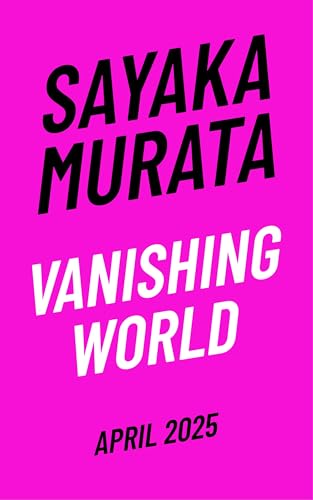
Strange and unsettling lightly speculative fiction from a provocative author.
Like with her previously Englished novels and story collections, Murata returns with a surprising novel of pointed social commentary. Though this one was too heavy-handed for my taste, it included enough nuance to captivate me most of the way through. I could have done without some of the repetition. We stay within the narrator’s point of view. It’s told in the first person. The world of the novel is different in one key way from our own. Artificial insemination is the sole means to reproduce. But our narrator doesn’t buy into this strange state of affairs by virtue of her own traditional conception. That leads her to become fixated on the topic. In 200+ pages of interior monologue interspersed with maid-and-butler dialogue, we are treated to a continuous onslaught of opinions. She does not like this world. This other thing about society doesn’t make sense, etc. Most of it comes into the fore like a non sequitur.
The novel as a whole lacks description. A few key images include the external womb worn for the purpose of male pregnancy, the Kodomo-chans (children raised by the community as a whole), and a few details of her living situation. We are given few visuals. You could call this a novel of ideas. It does not delve particularly deeply into these topics, but skims over all of them, offering summaries of how things are. We do not learn much about why our narrator differs from the pack who go through their lives without the burden of sex. How sex faded from societal consciousness in the first place is not discussed. Things are the way they are. The author embarks on her philosophical essay in novel form without establishing a chain of cause and effect.
One might surmise that she picked out key points from real life and twisted them into a scenario reminiscent of those confusing nightmares without context that sometimes assail us, leaving us with a distorted view of a dream world of sheer exaggeration. Her story collection, Life Ceremony used the same technique to better effect. Skewed worlds where familiar human struggles take on new form.
The narrator is so fascinating by the interplay of genders and sexualities around her that she constantly accosts everyone within range with politically incorrect questions. It’s clear that the main character is a mouthpiece for the author’s analysis of society’s biases and hang-ups. What do people worship, if not their bodies and the unions of those bodies? She seems to land on a notion that a collective working toward raising everyone on an equal playing field without individual flaws, in a watered down oasis free of desire and want would somehow cure the ill of loneliness.
Our narrator says: “Love is about having the courage to be called a pervert.” To society, her thinking is wrong, though it stems from the traditions of the past. She tries to convert a few others along the way, but succeeds in resisting only certain aspects of brainwashing, which seems to settle over her mind through osmosis, in her feeble attempts at assimilation. This book is very thought-provoking, but it is not as expertly crafted as her other available works. It is meant to shock and offend common sensibilities and succeeds on many levels. But as a novel, it does not contain an immersive story or fleshed-out setting or believable characters.
 L. S. Popovich
Leave a comment