
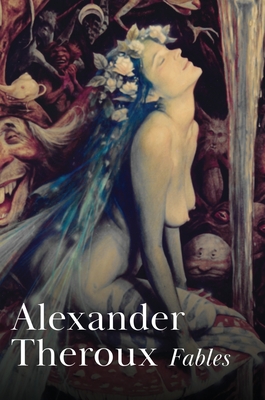
A few good and shiny examples of rare Theroux wit.
But mostly not. I say rare because his humor is an acquired taste, and it can also spoil after a time. The Therouxian works released by Tough Poets Press are glorious in theory but do not compare to the author’s two or three magnificent “early” works. I wrote longish reviews of the other two recent short stories collections. This third one disappointed me the most. I like the idea of Theroux writing light-hearted fabulist tales, like Angela Carter or Ducornet, but his conception of “fable” is confusing in my opinion.
The first, shorter pieces are more entertaining morality tales with subtle supernatural elements. But in this volume the author quickly slides back into the accustomed mode of longer, heavily detailed mish-mashes of history, trivia, character lampooning, and questionable subtext. The bulk of the stories here are indistinguishable from those in the other two volumes mentioned and hardly merit the appellation of “fables.”
He often seems to be writing around his factoids, such as in the tale of an orchid expert on a quest for a black orchid in South America. The facts are culled from research books and notes and shoehorned into the adventure story. He throws everything into the pot until it runneth over. There are thousands of tidbits he can’t help but include in these shoddy frameworks of storytelling, mainly consisting of quirky Americanisms, wisecracks about other cultures, moral judgements, and historical and lexical baubles—while occasionally fascinating, they would have surely been cut by most editors. The connective tissue weakens and the obscure words are distracting. Too often, he throws in biblical quotes, which makes the reader wonder if he is trying to say something about religion, but most of the time it’s just another quote amid a few dozen convenient references. The sentences are a mixed bag of excellent observations and queasy authorial sidelines. More times than I could count, a typo or awkward transition rendered a contrived sentence effectless or simply annoying.
The typos have always been a problem, I suspect because of multiple drafts being sent to the publisher while the book was in production. Theroux strikes me as one who does not countenance editorial advice. A lot of authors who do not identify with “genres” do that, producing idiosyncratic works that do not conform to tropes. But Theroux’s method is ranging pretty far afield from his comfort zone of Warholic or Darconville. Authors should have a space to publish works that do not resemble what the market demands, but a little editorial feedback can go a long way, despite what some authors are willing to admit.
What you get with these so-called fables are pessimistic, mean-spirited forays into lives, detached from the modern age by centuries. The locales are varied: South America, Russia, Germany, Switzerland, the Netherlands, Egypt, America, and China. When he spoofs a lot of these cultures it is too easy to come off as offensive. His jokes are just not funny to me. So why do I read his stuff?
I find many of his viewpoints intelligent. His satire is rich with textual allusion. There is much to admire in his esoteric vocabulary. The stories are not difficult to understand, merely difficult to enjoy. Like his poetry, which I have perused, there are too many wicked asides. The language delights in making fun of people, yelling out fatty when an overweight character walks on the scene (which is very often). The diction and syntax are expert when they have been polished.
He does not rely on existing fables, but branches out and creates his own definition of the word. There is much imaginative frivolity, and some interesting side quests. His very distant viewpoint, opting for the omniscient in every case, gives the sense of a travel account, of an antiquated mystic’s rambling fireside recounting.
“The Oxholt Violin” is a barely veiled history of violins in the guise of a story. The author has a tendency to tack on an ending – usually a violent, unexpected massacre of characters he has been ridiculing. You’ll see that happen multiple times in this book.
“Captain Birdeye’s Expedition” is rife with convincing details from a bygone era, like a catalogue of arcane remedies and products you might find in a foreign antique shop. His exhaustive research produces some unique moments. He is a consummate list-maker, though the storytelling is nothing to write home about. It may be difficult for some readers to get immersed since it is all telling and no showing, like most pre-1900 stories/ novels. The extremely distant narrator describes events in a way that might be easily construed as the author’s own opinions slathering the page. In the end you will likely delight in a few pieces from the collection, but definitely not all of them. I devoured some sections while slogging through others.
“Song at Twilight” was rather like Doblin’s “Chinese” novel, The Three Leaps of Wang-Lun, that is, a Chinese allegory written by a Westerner. As someone who loves reading actual Chinese authors, this story was just lame. Trying to pass these characters off as Chinese, describing all of these customs and beliefs, and stitching them into a semblance of a story felt like a nasty jab at a 5000-year-old body of literature he has only skimmed.
One final note: Theroux seems to be skirting the topic of religion. “They say that God is everywhere, and yet we always think of Him as somewhat of a recluse,” as he quotes Dickinson elsewhere, also adding “I daresay, an integral part of the possibilities she and I acknowledge is simply the process of seeking Him out.” Is he therefore saying that writing is his way of seeking out God? I am tempted to consider that Theroux has written extensively about religious subtexts, but it is difficult to pin down what he is trying to say. Seeking God is also a troublesome idea. Why spend so much time and effort seeking something omnipresent? I would just prefer it if Theroux stopped goofing around and wrote with some sincerity about these topics. Lampooning is only fun until it grows tiresome.
 L. S. Popovich
Leave a comment