

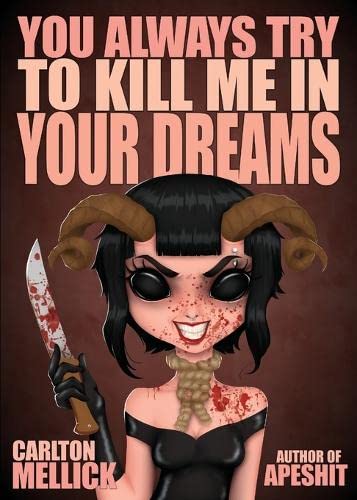
Solid storytelling in this novella, with some slasher concepts a la Nightmare on Elm St. His books of late have all had a Goosebumps for Adults vibe, which is not a disparagement.
In YATTKMIYD, CM3 satirizes the distinctly American college-age pursuit of perpetual drunkenness. He is a good writer in my opinion not because of polished sentences or deep philosophy, but in respect to his ability to create believable characters. You will hate some of them and root for others. Any author who is able to design a character to elicit a response from the reader is usually also able to design a plot to do the same. Well-couched in genre fiction, Mellick still manages to avoid some clichés, while embracing others, mixing the expected with the unexpected, fan service with surprises. The ending was open to interpretation, but much more interesting than the rest of the book. I felt for Elias, our protagonist, as he is gaslighted and abused. This theme of putting the main character through a hellscape of slightly skewed modern life has been repeated throughout his oeuvre, and is mightily convincing here. The present tense perspective felt a bit too faddish though.
As usual, the book capitalizes on humor, gross-out factor, and some goofy violence. Most characters act the way characters typically act in horror films, which is to say they seem determined to sprint toward their own inevitable demise.
Of course it was not non-stop fun. The way several characters repeatedly glance at or mess around with their electronic devices multiple times per page became irksome. I read books in order to escape this irritating behavior. Of course, Mellick sees the phenomenon in our culture and puts it in his book. It is an alternate history of now, where the bleak reality of living is too egregious to tolerate on a daily basis, and young, aimless students can’t face the void of ineluctable adulthood.
Aside from the virtual instructor who elicited laughs, I noticed the inclusion of side characters illustrating various layers of youth, whose radical activism and ennui is bloodborne and recursive throughout, coupled with such contemporaneous tics as that peculiar modern mental disease which causes some people to utter the word “bro” at the end of every sentence.
In terms of flaws: Roe’s penchant for dream-slaughter ceases rather abruptly. She awakes into a dream consciousness, departing from her instinctive behavior into full awareness of her dual nature. It seems that her partial spontaneous combustion was an arbitrary constraint lacking purpose. Several aspects of the scenario were not fully fleshed, and the ending flew by. He could have carried it further, but the last line of the book stirred a lot of emotion.
 L. S. Popovich
Leave a comment