

Admittedly, I have asked ChatGPT to write plenty of sequels to “The Library of Babel.”
I have thought about the story ceaselessly. I have written my own fan fictions here and there. Borges was quoted as saying “I imagine Heaven as a kind of library.” The author of this book turns a library into Hell. The psychological torment the characters find there is just as trying as any physical discomfort. It’s like that Twilight Zone episode where the bibliophile is the last person left alive and then he breaks his glasses – even though he could just go find another pair – but the point is, even reading has limited entertainment value. You begin to notice something after you read a few thousand books. That feeling, that joy, that transport of the mind and soul, becomes difficult to pin down. Many books don’t hold the same magic as they did when you were young. Innocence replaced by experience. You begin to read for lack of anything else to do. Reading can become boring if you’re not careful. Books begin to blend together in the mind. You seem to only preserve pieces of them, and the pieces never lead to lasting fulfillment. Books become fragmentary memories, washed out by the white noise of the Consumerist entertainment mill. Are any books necessary, after you’ve already read several thousand? Would ten thousand more make any difference? If I could only read one more book for the rest of my life, which would I choose. I ask myself silly questions frequently. Most of these questions involve books in some form.
This novella was a fun thought experiment, a corollary of the short story by Borges – which I believe can leave no reader unaffected. The true power of that story lies in its indelible imprint on the imagination. You can easily think back and revisit the library of Babel in your mind anytime. There is also a very boring website where you can read any text from the library of Babel. It is true that your exact thoughts are detailed somewhere in the library, along with every thought you have never thought. Every book that has been written and every book that has never been written is present in the library. Every combination of words and every combination of letters that are not words. The author spends several pages explaining the structure of the story – which Borges does more succinctly in his version. But the understanding of how it works is completely necessary. I have taken the concept even further in my own mind to encompass not only letters in the alphabet we use but the letters of every extant alphabet, and the alphabets of every alien culture, and completely unknown and uninvented alphabets. You can transpose alphabets into code so that E no longer means E but actually represents X, and so forth. If there is any end to the permutations, it approaches infinity.
I have a few grievances with Peck’s story. The fact that he made the main character Mormon, but he did not allow that character to incorporate some tenants of his faith into his analysis of Hell. For instance, did you know that the Mormon’s are recording millions or billions of names in an endless genealogy stretching back through time in order to secure the salvation of dead relatives? They have physically printed these names in millions of volumes in their archives. An opportunity was missed here. The Mormon religion is host to interesting practices that might have been shoehorned in, though some readers would probably grow aggravated by any sort of agenda. This story does not feel religious. It feels like pure fantasy, like the afterlife scenarios of Carlton Mellick. You would never want to be condemned to them, but they’re interesting to visit, like a museum, or in the case of Mellick, more like Meow Wolf.
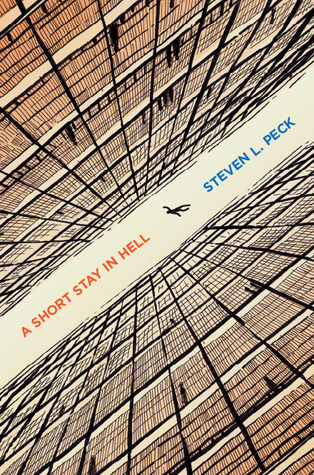
The book goes into Zoroastrianism briefly, illustrating the soul transference process with a cartoonish demon. Once the reader is actually in the Hell of Books, the claustrophobia is palpable.
Imagine a nearly infinite building, no windows, no view of an outside, no structural problems, just uniform walls of shelves, stretching on for light years. A trillion years of wandering becomes an insignificant length of time to our protagonist. All bodily needs are provided for (though I would argue that things like sleep, eating, drinking, and defecation, etc. somehow ruin the purity of the soul’s journey in this realm). The library is self-healing. If you toss books off the edge of the railing they reappear in the morning. If you tear out pages, the books are intact in the morning. Again, the characters’ inability to change the library makes their search more futile. They are tasked with finding the book of their life. But this vague mission is far too amorphous to accomplish in any reasonable number of eons. Consider that it takes at least a million years of reading nonstop, of scanning books, to come across a single coherent sentence longer than ten words.
The fact that there are other people there is a saving grace. If you were alone, it would be a purer Hell. Then again, Satre said that Hell is other people. Of course, in the story our hero finds people who have lost their minds, who have started cults, and he falls in love with people only to lose them. The experiences were a bit limited in my opinion. I could have gone on reading this book for another 1000 pages. The possibilities are nowhere near exhausted, and I hope we get a sequel. Imagine a Library of Babel where every book is the Book of Sand. (Read the Borges stories if you don’t know what I’m talking about).
Imagine this, we somehow train an AI to search the Library of Babel for meaningful text. Would that be easier than training an AI to impress us with its creative ability or lack thereof? When we start roping AI into the idea my mind gets slippery. The whole reason it is interesting is the emotional aspect of the thought experiment. We can tell AlphaZero to play a million games against Stockfish, but would we just grow bored? Then again, why haven’t there been more games between the two? I think it is because we need to preserve the human element. If we take Magnus out of the chess world and just pit AIs against one another, people might stop caring. You can root for an AI, but it’s less satisfying.
Luckily, the author gives us a protagonist the reader can root for. He presents his mission clearly in the beginning and end. He gives us the constraints and recounts some of his experiences. We get to follow him through his journey, but it is just a sliver of the whole. So much must have happened in the intervening years that the mind reels. The true beauty and power of this story lies in imagining what you would do. The book is like Play-doh in your mind. You can shape it into any form and carry it along with you.
In the end, it is a metaphor for life if you want it to be. We are searching for meaning. We can strategize all we want but the universe remains chaotic.
The only mode of transportation between floors is gravity, or the staircases. The protagonist chooses to plunge downward more than once, in an effort to prove there is a bottom. But falling light years at the speed of terminal velocity takes a truly ridiculous amount of time.
They don’t have to worry about injury or starvation – it still happens, but they always heal.
One might conceive of the scenario as a psychological realm, a procedurally generated simulation, in which people are hooked up, Matrix-style, and fed false realities for all eternity. It would seem that the demon who vets souls had the ability to choose separate Hells for people. If that is the case, is Borges’ the one you would choose. That is, if you could only do one thing for all eternity, would you choose to read?
 L. S. Popovich
Leave a comment